Erich-Weinert-Straße, Seelow, Brandenburg (Arbeitstitel), Jonathan Zwiener
Inhalt
Die Bachelorarbeit untersucht das Kulturhaus-Areal in Seelow, wo Wohngebäude aus den 1950er-Jahren zugunsten einer Erweiterung der Kreisverwaltung Märkisch-Oderland zur Disposition stehen. Das Projekt setzt vor offiziellen Beschlüssen an und versteht sich als dokumentative, stadtforscherische und planerisch-strategische Intervention in laufende Entscheidungsprozesse. Ziel ist es, sozialen Wohnraum zu erhalten, Segregation durch Umsiedlung zu vermeiden und Umbaukultur als klimagerechte Alternative zum Abriss zu stärken.
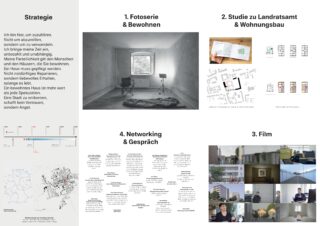
Neben räumlich-strategischen Szenarien für eine Verwaltungserweiterung im Bestand – durch Aufstockung, Anbau und Nachverdichtung – untersucht die Arbeit die Umbaupotenziale der bestehenden Wohnhäuser. Die Studie für Entscheidungsträger ist dabei eine von mehreren Interventionen.
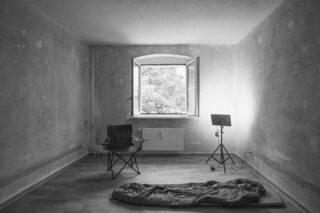
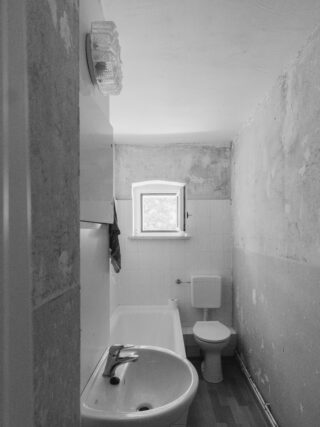
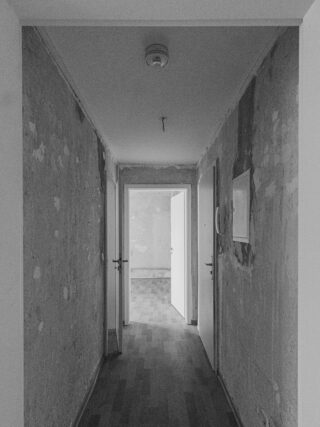
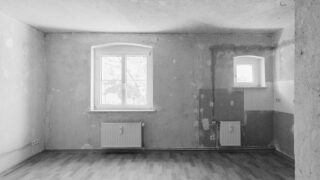
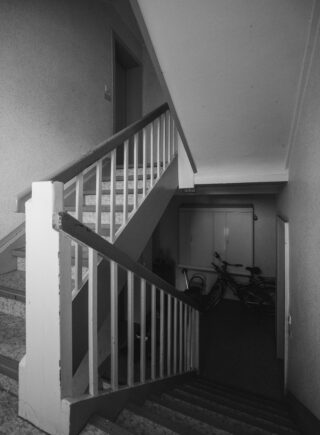
Für drei Wochen lebte ich selbst in einer der „technisch leerstehenden“ Wohnungen auf dem Areal. Diese Feldforschung vor Ort ermöglichte eine räumliche und soziale Innenperspektive, die in Gespräche, Entwurfsstrategien, eine Fotoserie und einen Film einfließt. Über 50 Gespräche, die ich mit Verwaltung, Politik, Expert*innen und Bewohner*innen führte, bilden die Grundlage für eine informierte öffentliche Debatte und laufen weiter.
This bachelor thesis examines the Kulturhaus area in Seelow, where residential buildings from the 1950s are under consideration for demolition to enable the expansion of the Märkisch-Oderland district administration. The project intervenes before official decisions are made and positions itself as a documentary, urban research, and strategic planning contribution to an ongoing political process. Its aim is to preserve social housing, prevent displacement, and strengthen adaptive reuse as a climate-conscious alternative to demolition.
In addition to proposing spatial strategies for administrative expansion within the existing structures—through vertical extensions, additions, and densification—the thesis explores the transformation potential of the residential buildings. The study for decision-makers constitutes one intervention among several.
For three weeks, I lived in one of the technically vacant apartments on site as part of my field research. This embedded perspective informed interviews, design strategies, a photographic series, and a documentary film. More than 50 conversations with officials, politicians, experts, and residents form the basis for an informed public discussion.