
Wall Painting Conservation
Inhalt
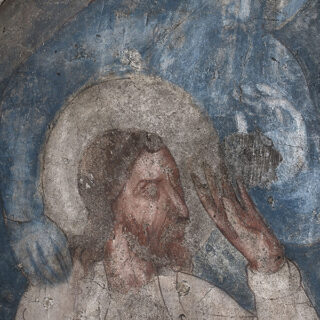
The degree programme in the Conservation and Restoration of Wall Paintings, Architectural Surfaces and Polychrome Stone focuses on the conservation of art and architectural heritage, as well as archaeological and museum artefacts.
The degree programme is designed, in the broadest sense, as a project-based programme. This means that methods, procedures and techniques can be developed, implemented and completed through specific projects within a holistic context – as in subsequent professional life – and through collaboration with other experts. The programme operates in close cooperation with other disciplines and higher education institutions, thereby fostering practical interdisciplinary collaboration.
The degree programme was established in 2003 and has, since then, built up an excellent network of national and international contacts through partnerships with heritage conservation organisations and museums. Of particular note is the close collaboration with the Landesamt für Denkmalpflege Baden-Württemberg (Baden-Württemberg State Office for the Preservation of Historical Monuments), which ensures that the programme is directly integrated into the local arts and cultural landscape and has access to fascinating case studies for research and practical work.
Outline of the profession
The field of work undertaken by conservators specialising in mural painting, architectural surfaces and polychrome stone is one of the most fascinating areas of art and historic building conservation. Art and cultural heritage, with their need for preservation, demand a constant dialogue with the object itself and the disciplines involved.
Career opportunities in the field of conservation and restoration are expanding steadily. This profession can be practised on a self-employed or freelance basis, with the option of working as part of a team, or as a salaried employee in museums, collections or research institutions, as well as in the field of heritage conservation, both nationally and internationally.
The work of conservators encompasses a wide range of conservation and restoration tasks, from planning through to practical implementation, including documentation. The conservation and restoration support for art exhibitions forms part of their remit, as do climate monitoring and providing advice on preventive conservation. The combination of theory and practice also opens up opportunities in research and teaching.
Further information on this career is available on the website of the Verband der Restauratoren VDR (Association of Conservators).
Bachelor’s degree
Duration and degree
| Duration of study | Standard period of study 6 semesters |
|---|---|
| Degree | B.A. (Bachelor of Arts) |
| ECTS | 180 |
Course content
The Bachelor’s programme provides students with the fundamental knowledge of the subject. Cross-disciplinary lectures and tutorials cover basic techniques for academic work, documentation and media literacy, whilst also laying the foundations in the natural sciences and the humanities. The interdisciplinary curriculum is supplemented by subject-specific lectures and seminars in materials science, art technology and conservation science.
Furthermore, students learn to assess the material composition of objects and their ageing processes in the context of their cultural significance. They gain an understanding of the professional evaluation of objects and materials, as well as methods for preserving them and repairing damage. This is accompanied by an in-depth understanding, from a materials science perspective, of historical, craft and artistic techniques, as well as modern conservation methods. Many interdisciplinary topics complement the subject-specific course of study, creating a varied and creative environment.
A large part of the Bachelor’s degree programme at the ABK Stuttgart is devoted to working on original objects, meaning that the practical component of the programme accounts for over 50 %.
Field trips both at home and abroad complement the curriculum and encourage students to engage with other disciplines.
Bachelor’s thesis and final examination
The Bachelor’s programme concludes with a four-month Bachelor’s dissertation and a final examination, leading to the award of a Bachelor of Arts (B.A.), and corresponds to Level 6 of the ‘Professional Guidelines’ of the European Confederation of Conservator-Restorers Organisations (E.C.C.O.). ecco-eu.org
Upon passing the Bachelor’s degree examination, graduates are eligible for a place on a Master’s programme. The B.A. degree does not yet qualify graduates to practise their profession independently, which is why the M.A. degree is recommended.
Regulations
Master
Duration and degree
| Duration of study | Standard period of study 4 semesters |
|---|---|
| Degree | M.A. (Master of Arts) |
| ECTS | 120 |
Course content
The Master’s programme is characterised by a wide range of options and a high degree of academic freedom. The focus is on project work carried out on selected objects in the specialisms of mural painting, architectural surfaces and polychromy on stone, which gradually leads to students working independently and taking personal responsibility for their work. This means that conservation and restoration concepts are developed independently and put into practice.
Part of the MA programme is devoted to a short theoretical research project and corresponding practical experiments, which pave the way for the independent development of new conservation and restoration strategies.
Master’s students can choose from a wide range of block courses in the fields of materials science, archaeometry, art technology and conservation science, as well as modern objects and contemporary art, selecting those that interest them most and thus developing their own specialist profile (see the module handbook).
Master’s thesis
The Master’s programme culminates in a six-month Master’s thesis. Upon successful completion, students will have acquired skills in line with Level 7 of the E.C.C.O Professional Guidelines (ecco-eu.org). The M.A. degree qualifies you to practise the profession independently and to pursue a PhD.
Regulations
Master’s Theses
2021
Kulzer, Susanne. Bundesfestung Ulm / Neu Ulm: Werk XXXV, Fort Oberer Eselsberg, Nebenwerk – Maßnahmendiskussion zum Umgang mit dem Mauerwerk.
2020
Gugliuzza, Lidia. Schadensanalyse mittels digitaler 3D-Modelle am Beispiel der Lourdesgrotte in Hausen am Bussen.
Holzkamp, Lena. Salzreduzierung – Ein Vergleich des Vakuum-Wasch- und Kompressen- Verfahrens am Beispiel des Stubensandsteins am St. Salvator in Schwäbisch Gmünd.
Schellbach, Katharina. Die Wandmalerei in der Allerheiligenkapelle im Esslinger Stadtarchiv – Bestandsaufnahme und Erstellung eines Konservierungs- und Restaurierungskonzepts.
Walz, Silja. ‘E bundisch Bischöfsche’ – Untersuchung der Skulptur ‘Stehender Bischof, LH 34’ aus der Liebieghaus Skulpturensammlung, Frankfurt am Main.
2019
Klein, Viola. Rohrmelasse und -zucker als Zusatz in Kalkmörteln für die Konservierung.
Mertens, Lea. Riessuevit – Konzeptentwicklung zur Behandlung von Rissen.
2018
Armbruster, Frederik. Bauplastiken des Kreuzgangs Heiligkreuztal.
Fischer, Friederike. Die polychrom gefasste Bauplastik der Chorscheitelkapelle im Heilig-Kreuz-Münster in Schwäbisch Gmünd.
Mirea, Ioana. Die Wandmalereien der südöstlichen Sakristei der Marienkirche in Reutlingen- Bestands-, Zustands- und Schadenserfassung und Erstellung eines Konservierungs- und Restaurierungskonzeptes.
Toyoda, Satoko. Vergleichende Untersuchung der Werktechnik von elf altägyptischen Totenstelen aus der 12. und 13. Dynastie .
2017
Gouin, Mathieu. Untersuchung zur Betonpolychromie der 70er Jahre am Beispiel zweier von Otto Herbert Hajek gestalteten Bauwerke.
2015
Kolar, Teresa. Schloss Heiligenberg – Architekturoberfläche und Wandmalereiein in der Fürstlich Fürstenbergischen Kapelle.
Krautheimer, Anna Lisa. Die Wandmalereien des sogenannten Jakobsbads in Horb am Neckar. Erstellung eines Konservierungs- und Restaurierungskonzeptes .
2014
Jacob, Johannes. Die Minoritenmadonna in Wien – Bestands- und Zustandsserfassung mit Schwerpunkt auf die erhaltenen Fassungen und Erarbeitung eines Konservierungs- und Restaurierungskonzeptes.
Diploma Theses 2007–2014
2014
Koch, Claudia. Die gotische Brunnensäule des Rottenburger Marktbrunnens – Bestands-, Zustands- und Schadenserfassung mit Konzepterstellung für die Konservierung und Restaurierung sowie Präsentation.
2013
Fischer, Lisanne. Ein Tafelfresko von Georg Muche – Analyse der Werktechnik – Bestands- und Zustandsaufnahme – und Erstellung eines Konservierungs- und Restaurierungskonzeptes.
Proske, Ramona. Kapelle St. Jodokus in Überlingen am Bodensee – Untersuchung zu Bestand und Schäden sowie Entwicklung eines Konservierungs- und Restaurierungskonzeptes der Wandmalereien im Bereich B 2.2 der Südwand im Langhaus.
2012
Mrosk, Anja. Translozierte Wandmalereien auf der neu errichteten Ostwand in der Petruskirche Jesingen/Teck.
Pfeuffer, Carolin. Untersuchung zur Steinpolychromie am Beispiel eines Figurenkomplexes von dem Haus am ehemaligen Marktplatz 5 in Stuttgart sowie Entwicklung eines Konservierungs- und Restaurierungskonzeptes.
Prochniak, Maria. Das Altarbild der Peter-und Paulus-Kapelle im Freiburger Münster Unserer Lieben Frau – Zustandserfassung mit maltechnischer Untersuchung und Konzepterstellung zur Konservierung und Präsentation.
2011
Hirschfeld, Claudia. Der Kreuzgang-Südflügel im Münster Unserer Lieben Frau in Konstanz – Bestands- und Zustandserfassung sowie Erstellung eines Konservierungs- und Präsentationskonzeptes unter besonderer Beachtung der Gewölbemalereien.
Kaiser, Nicole. Schloss Ludwigsburg – Dienerschaftsraum/Raum 133 – Bestands- und Zustandserfassung sowie Entwicklung eines Konservierungs- und Restaurierungskonzeptes unter der Berücksichtigung einer späteren Präsentation des Raumes.
Reinecke, Marie-Luise. „Basler Triptychon“ 1960 von Otto Herbert Hajek – Erstellung eines Konservierungs- und Restaurierungskonzeptes.
2009
Lang Viola. Die Wandmalerei von Rudolf Yelin d. J. in der ev. Kirche in Pflummern – Untersuchung der Werktechnik und Entwicklung eines Konservierungskonzepts.
Roth, Janina. Die Wand- und Gewölbemalereien der Sylvesterkapelle des Münsters unserer Lieben Frau zu Konstanz – Untersuchung zu Bestand und Schäden und Entwicklung eines Konservierungs- und Restaurierungskonzeptes.
Stark, Anja. Untersuchung des „Donndorf Nachlasses“ im Außendepot der Stadt Stuttgart, Restauratorische Untersuchung.
2007
Brodbeck, Anja. Studie zum Umgang mit Wandmalereifragmenten – Beitrag zur Forschung des technologischen Aufbaus römischer und frühmittelalterlicher Wandmalerei aus dem süddeutschen Raum.
Liebstückel, Kerstin. Metallauflagen auf Stuck am Beispiel der Sommerabtei im Kloster Ottobeuren.
Research
Research Projects
Doctoral programme
ABK Stuttgart has been offering doctoral programmes since 2002. It provides graduates of ABK Stuttgart and other universities with the opportunity, following completion of their Master’s thesis, to devote themselves to a multi-year research project and to make original contributions to the still nascent but dynamically developing field of conservation science.
Anyone wishing to pursue an academic career following their Master’s degree has the opportunity to undertake a doctorate at the ABK in the programme on the conservation and restoration of archaeological, ethnological or craft objects. If you are interested in such a doctoral programme, please contact the programme director.
The PhD regulations and further information on the PhD process, funding opportunities and current and completed PhD projects can be found under ‘Doctoral programme’.
Further Information


News
Staff
Professors

Academic associates


External lecturers (BA)
- Dipl.-Ing. Justus C. C. Dietz, Stuttgart: Documentation Techniques: Technical Drawing
- Jan Hooss, Stuttgart: Stucco production
- Dr. Dipl.-Rest. Dörthe Jakobs, Stuttgart: Theory and practice of integrating defects
- Dipl.-Rest. Claudia Koch, Heidelberg: Mural Removal
- Christian Köllner, Lauf: Clay working
- Dipl.-Rest. Astrid Wollmann
- Dipl.-Rest. Viola Lang, Bad Grönnenbach: Modern painting materials in mural painting
- Dipl.-Rest. Martin Lehmann, Meissen: The use of synthetics in mural painting
- Steffi Maier, Crailsheim: Mural painting techniques
- Dr. Stefanie Scheerer, Stuttgart: Microbiology, Safety Induction
- Dipl.-Rest. Barbara Springmann: Gilding techniques
- Dr. Karl Stingel, Graz: Historical binders: lime and gypsum
- Dipl.-Rest. Astrid Wollmann: Plastics
- Dipl. oec. Andrea Wörner, Stuttgart: An Introduction to Tax Law for Students During Their Studies
- Dipl.-Ing. Justus C. C. Dietz, Stuttgart: Documentation Techniques: Technical Drawing
- Jan Hooss, Stuttgart: Stucco production
- Dr. Dipl.-Rest. Dörthe Jakobs, Stuttgart: Theory and practice of integrating defects
- Dipl.-Rest. Claudia Koch, Heidelberg: Wandmalereiabnahme
- Christian Köllner, Lauf: Lehmverarbeitung
- Dipl.-Rest. Astrid Wollmann (?)
- Dipl.-Rest. Viola Lang, Bad Grönnenbach: Moderne Malmaterialien in der Wandmalerei
- Dipl.-Rest. Martin Lehmann, Meissen: Umgang mit Kunststoffen in der Wandmalerei
- Steffi Maier, Crailsheim: Wandmalereitechnik
- Dr. Stefanie Scheerer, Stuttgart: Mikrobiologie, Sicherheitseinführung
- Dipl.-Rest. Barbara Springmann: Vergoldungstechniken
- Dr. Karl Stingel, Graz: Historische Bindemittel: Kalk und Gips
- Dipl.-Rest. Astrid Wollmann: Kunststoffe
- Dipl. oec. Andrea Wörner, Stuttgart: Einführung in das Steuerrecht für Studierende während des Studiums
External speakers (M.A.)
- Dr. Katharina Blänsdorf, München: Polarisationsmikroskopische Pigmentuntersuchung
- Dr. Christiane Brasse, LAD BW: Bauforschung
- Raymond Bunz, Owingen: Methoden der Oberflächenreinigung
- Prof. Dr. Arnulf Dähne, Altenburg: Existenzgründung / Ausschreibungsverfahren
- Dipl.-Rest. Frank Eger, Balingen-Ostdorf: Steinkonservierung
- Dr. Julia Feldtkeller, Tübingen: Theorie und Geschichte der Denkmalpflege
- Prof. Dr. Gabriele Grassegger-Schön, HFT Stuttgart: Werkstoffprüfung und Salze
- Teresa Kolar, LAD BW: Struktur der Denkmalpflege, Existenzgründung
- Bill Landsberger, Berlin: Integrated Pest Management (IPM)
- Prof. Dr. Steffen Laue, FH Potsdam: Salze im porösen Systemen
- Dipl.-Ing. Architekt Till Läpple, Stuttgart: Statik von historischen Gebäuden
- Mag. Johann Nimmrichter, BDA Wien: Laser in der Konservierung
- Dr. Stefanie Scheerer, Stuttgart: Mikrobiologie
- Dipl.-Rest. Barbara Springmann: Existenzgründung
- Dipl.-Rest. Eric Stenzel, Dresden: Laser in der Konservierung
- Marco Tornarolli M. A., Stuttgart: Bauphysik
- Dipl. oec. Andrea Wörner, Stuttgart: Steuerrecht, Existenzgründung
- Dr. Judit Zöldföldi, MPA Stuttgart: Steinkonservierung und zerstörungsfreie Untersuchungsmethoden in der Denkmalpflege