Institute for Conservation Sciences
Inhalt
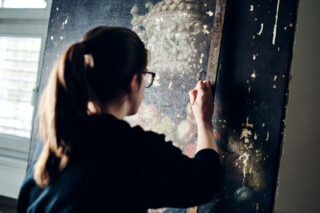
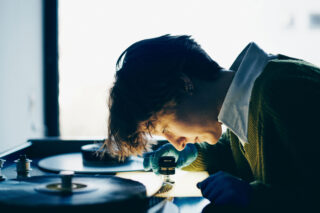
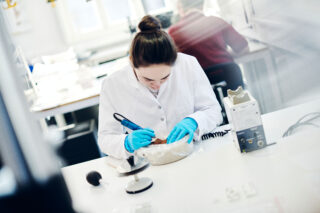
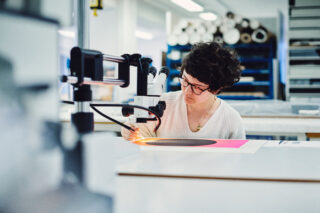
The overarching aim of the Institute for Conservation Sciences is to promote cooperation between institutions in Baden-Württemberg that are involved in the arts and classical studies, art technology and the conservation of art and cultural heritage.
The Institute of Conservation Sciences regularly organises public lectures and presentations. These showcase the latest and most fascinating research and projects in the fields of conservation and restoration, covering a wide range of topics relating to the handling of cultural heritage. The events usually take place during the lecture term (winter term: October to February; summer term: April to July). The lectures take place two to three times per semester, on Wednesdays in the early evening, and are held in person, in a hybrid format or entirely online via Zoom. Details of all events and information on how to take part can be found in the calendar.
News
About the Institute
The Conservation and Restoration degree programmes are brought together, both academically and strategically, within the Institute of Conservation Sciences. In accordance with its statutes, the Institute actively promotes cooperation with museums, heritage conservation bodies, other higher education institutions and the business sector through innovative development projects. In addition to working closely with the Department of Art History at the Academy, we are linked to the network of museums in Stuttgart and Baden-Württemberg, the State Office for the Preservation of Historical Monuments, the State Library and the State Archives, as well as to research institutions beyond the state’s borders. The Institute is dedicated to teaching and research, the implementation of development projects and the provision of consultancy services in all areas of the conservation of art and cultural heritage. The organisation of symposia, seminars and lectures, further education and training programmes for conservators, the publication of specialist literature, and the operation and expansion of a reference library are also part of the Institute’s work. As part of its training and further education programme, the Institute offers courses in the fields of preventative conservation, art technology and conservation, the ethics and history of restoration, and the fundamental principles of the natural sciences and investigative methods.
We work on the basis of shared principles to ensure that the training we provide in the conservation disciplines we represent is in keeping with the times. Our work is underpinned by a commitment to adopting nuanced approaches to the conservation of art and cultural heritage.
The Institute’s responsibilities include
- Support for students and degree programmes in research and study projects
- Further training
- Support for teaching
- Organisation of conferences and lectures
- Networking between the department and the wider academic community
- Encouraging discussion on new perspectives within the profession
Management and Advisory Board
Leitung
- Prof. Dr. Anna von Reden
Deputy Head
- Prof. Dr. Christoph Krekel
Laboratory for Archaeometry and Conservation Sciences
Advisory Board
Members within the Academy
- Prof. Dr. Andrea Funck
Conservation and restoration of archaeological, ethnological and craft objects - Dr. Andrea Fischer
Academic staff member and tutor in the workshop for the degree programme in the Conservation and Restoration of Archaeological, Ethnological and Art and Craft Objects
External members
- Dr. Dipl.-Rest. Kristina Holl
Head of the Department of Restoration and Conservation of Architectural and Artistic Monuments, State Office for the Preservation of Historical Monuments, Esslingen am Neckar - Anna Leippe M.A.
Director of the Baden-Württemberg State Film Archive, Stuttgart - Dipl.-Rest. Katja von Wetten
Head of Restoration and Collection Management / Exhibition Installation; Staatsgalerie Stuttgart - Dipl.-Rest. Katrin Holzherr
Head of Restoration, State Graphic Arts Collection, Munich
Articles of Association
Degree in Conservation Science




Selected projects and research
Further information on research into conservation and restoration can be found on the Research at the ABK Stuttgart page.
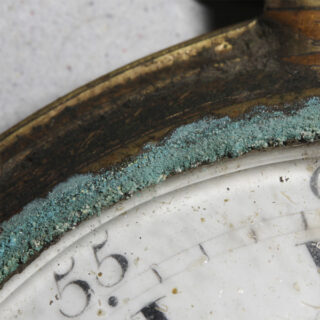
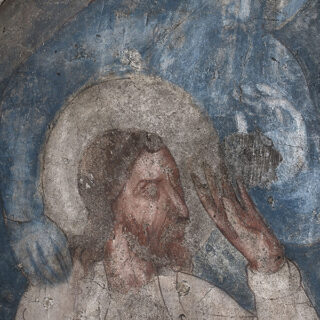
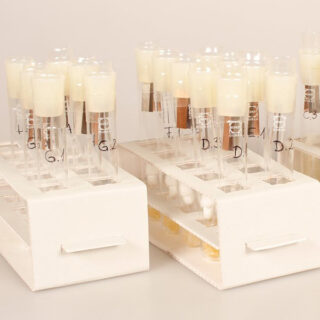
Kulturgut-Lab
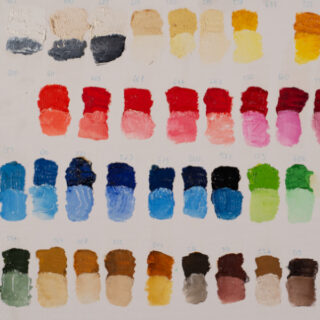
The Kulturgut-Lab (Cultural Heritage Lab) is a project run by students on the conservation courses at the State Academy of Fine Arts in Stuttgart. As a mobile teaching and learning laboratory, it brings home the importance of preserving cultural heritage, thereby highlighting the vital role that conservators play in our society.
The concept was developed between 2019 and 2021 under the leadership of art restorer Astrid Wollmann from the Württemberg State Museum, with funding from the Baden-Württemberg Ministry of Science and Research. The Cultural Heritage Lab showcases the quality of Stuttgart’s training programmes for conservators. The Institute – and, consequently, the degree programmes in restoration and conservation – regularly showcase the Cultural Heritage Lab at public events. For example, we are present at venues across Stuttgart during the annual European Day of Restoration.
Sister Cities
Collaborations between Stuttgart and St. Louis.
SLAM – Stuttgart Academy
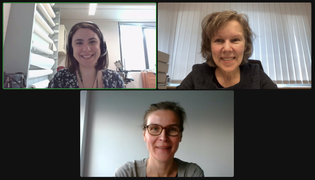
February 20, 2023: Irene Brückle and Ute Henniges from the Stuttgart Academy’s paper conservation programme meet with Sophie Barbisan from the St. Louis Art Museum. For July 2023, Sophie is invited to speak about her work as associate paper conservator at the museum in a digital meeting with the Academy’s paper conservation students. Sophie (upper left), Irene (upper right) and Ute (lower center) are also discussing common research interests.
Internships for art conservation students
The City of Stuttgart’s Sister Cities Programme enabled two students from the conservation degree programmes to undertake a five-week work placement at the Saint Louis Art Museum (July–August 2022).
The work placement was funded by the City of Stuttgart and supported by the Institute of Conservation Sciences. The two students recount this intensive and varied experience.
Two art conservation students from Stuttgart on internship in Saint Louis: a successful sister cities collaboration in cultural heritage conservation
by Lotta Knapp, Miyon Schultka, October 2022
How the 2022 internship at the Saint Louis Art Museum came about
We are two students of art conservation from the Stuttgart State Academy of Art and Design who traveled to Saint Louis in 2022 to spend five weeks as interns in the conservation department of the Saint Louis Art Museum in Missouri also known short as “SLAM” (Fig. 1). The internships were made possible within the framework of the Stuttgart – Saint Louis sistercities program. The sister cities celebrated their 60th anniversary in 2020, and on this occasion promoted an exchange on a scientific, economic and cultural level. These efforts led the city of Stuttgart to provide key funding for this internship through the Institut für Konservierungswissenschaften (institute for the study of cultural heritage) at the Stuttgart Academy.
Many impressions of museum and conservation work
The SLAM staff showed great interest in hosting us: Lotta Knapp, paintings conservation student, and Miyon Schultka, paper conservation student. SLAM, and in particular the conservation department headed by Hugh Shockey, were very generous in their preparatory support during the visa application process, finding affordable housing and other organizational matters. When we arrived on July 29th, 2022, we were welcomed very warmly and were introduced to our host institution and colleagues in the conservation department (Fig. 2). A lot of thought went into getting us connected this way, and we also got to know conservation interns from the United States and Canada and visited other departments in the museum. We also met with the director Min Jung Kim who supported the internship project. Several times, we attended the lunchbreak “brown bag meetings”, where members of staff from different museum departments discussed current projects. And we were invited to the conservation laboratories of other institutions in Saint Louis, for example, the conservation labs of the Missouri Botanical Garden and The Missouri History Museum. Thus, we gained a broad insight into the conservation responsibilities at SLAM and other major cultural collection institutions and learned about the work in different conservation specialties.
Internship work in conservation laboratories
Within our first week, we were already set to work in the two different laboratories, paintings and paper conservation.
Lotta Knapp: Working in the paintings conservation lab
During my internship in the paintings conservation laboratory, I was able take part in several professional key museum activities. I helped to deinstall an exhibition, learned about condition reports made for paintings that need to be documented for outgoing loans and I also got to know different departments of the museum. My main project concerned the conservation of a large bark painting which had been created by the Australian Aboriginal artist Nym Bunduk (ca. 1900|03–1974) around the late 1960s. The painting’s support is a stringy eucalyptus bark, its painted motif was created with an opaque paint. It is the paint that had suffered damages: it was powdering and flaking; some damaged areas had been overpainted and this added paint did not match the original. I consolidated the original paint layer with an appropriate adhesive to stabilize the artwork and prevent further loss (Fig. 3). Also, I toned some of the most disfiguring overpaint. I also contributed to public outreach in a video the museum created about this project. This proved to be another very interesting new experience (Fig. 4).
A highlight was that I was allowed to help prepare the museum’s oil painting on canvas Water Lilies by Claude Monet (1840–1926) for loan to an exhibition in Paris. This involved many intricate work steps that included local retouching and stabilizing small areas of this large painting (Figs 5 and 6).
Miyon Schultka: Working in the paper conservation lab
The museum had selected two main projects for me. One was the treatment of a chalk drawing by the Italian artist Giambattista Tiepolo (1696–1770). It was drawn in red and white chalks on a blue laid paper (Fig 7 and 8). Historical pre-museum storage situations had been quite unfavorable and likely involved high relative humidity conditions. This led to the deterioration of the paper and had resulted in many prominent brown stains, also known as foxing. A loss in the lower left corner of the paper had been previously filled with an unsuitable paper and an adhesive that caused severe staining of the adjacent original paper. To reduce the staining, we decided on a highly controllable local washing treatment using a suction platter. In this process, the chelating agent sodium citrate was used to soften the degraded adhesive and make it more easily soluble in water. When introducing the solution into the paper, the adhesive was more easily disintegrated and transported out of the paper into the underlying blotter by the low vacuum pressure.
Treating the stonecut Sea Spirits by the Inuit artist Napachie Ashoona Pootoogook (1938–2002) from 1964 posed some interesting challenges. The Asian handmade paper proved somewhat unusual in that it featured thick fiber strands that were brown from discoloration. Also, foxing was especially severe within the window mat opening. Finally, previous framers had used pressure-sensitive tapes of different qualities to fix the print in a window mat. The cloth and paper carriers of these tapes were thick and stiffened with age, which made it very difficult to remove them. The adhesive itself had caused severe staining and was very difficult to dissolve. Overall, the various stains and adhesives required us to test numerous solvents and several treatment approaches. In the end, we were successful in treating the print working in several stages on a suction table and with sheets of Gellan gum (Fig. 9). This gel material retains water and other solvents very well and delivers them in controlled ways into the paper object, while simultaneously transporting soluble degradation products out of the paper via capillary action. With this gentle yet effective cleaning, the print was successfully treated. Both treatments were valuable learning experiences in that they required cautious approaches that are optimized for the case at hand.
Outside SLAM: Learning about the local culture
Our experience also included a rich introduction to the culture and life in this vibrant Midwestern city. Already on arrival, we were greeted with a ride to our housing from the airport, received map and list of interesting locations in this culturally rich city. We spent a lot of our free time with other volunteers and interns from the United States and Canada and with members of the staff of the SLAM conservation department and were introduced to a variety of typical American and local dishes (Fig. 10). We went to music concerts and other cultural events, following up on recommendations by our hosts (Fig. 11). A unique experience was attending a Cardinals vs. Braves baseball game in the Busch Stadium. So, on top of learning professional skills, we were able to gain a deeper understanding of American culture and life outside of the museum boundaries.
What made this internship so special
Working in a vibrant conservation community at SLAM was a deep learning experience. It was extremely valuable to learn about current approaches and methods from the perspective of this major American museum. SLAM familiarized us with professional approaches in the diverse parts of their expansive collection. It introduced us to treatments and chemicals that we had not used before and allowed us to evaluate the methods we had already learned and made us see the many conservation responsibilities of today’s museum conservators from a new point of view. This enriched our outlook on the conservation profession as a whole.
Our gratitude goes to
The city of Stuttgart provided major funding to make this internship possible. We are very grateful for the sister cities program! This program enabled the enthusiastic support of the two involved institutions that made this internship possible – the Saint Louis Art Museum the Stuttgart State Academy of Art and Design. At SLAM, the project was encouraged by the museum director Min Jung Kim. Hugh Shockey, Head of the conservation department, was instrumental in setting the stage for the internship. At the SLAM conservation department, we are deeply thankful to our immediate supervisors, Melissa Gardner, Paintings Conservator, Courtney Books, Assistant Painting Conservator, and Sophie Barbisan, Associate Paper Conservator. They made this internship not only a profound educational experience but also a lot of fun. The other members of the conservation staff generously shared time to introduce us to other aspects of conservation. At the Stuttgart State Academy, the Institut für Konservierungswissenschaften spent much effort into creating this internship opportunity and supporting it financially through co-funding. We are particularly grateful to Irene Brückle, head of the Institute, for her initiative and support throughout.
Our wishes for the future
We hope that this valuable conservation connection between Saint Louis and Stuttgart will be fostered in the future and hope to return to Saint Louis in the future!
Contact for Ukraine Conservators
The Institute of Conservation Science at the Stuttgart State Academy of Fine Arts offers a contact for conservators with ongoing research projects. With the support of the Ukraine funding line of the Ernst von Siemens Kunststiftung and the Hermann Reemtsma Stiftung, we may be able to offer them a place to continue their work or arrange further possible contacts.
Contact (German, English): irene.brueckle@abk-stuttgart.de