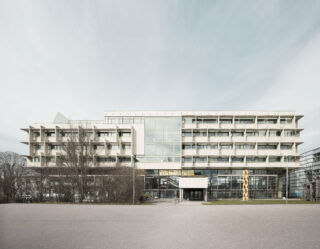
Weißenhof Institute
Inhalt
The Weißenhof Institute is an interdisciplinary platform at the State Academy of Fine Arts in Stuttgart. As an independent institute, it bridges the gap between design, artistic and academic practice. This cross-disciplinary collaboration fosters discussion on current topics, which are made accessible to a wide audience through symposia, workshops and publications. The Weißenhof Institute’s publication series is the ‘Schriftenreihe zur Architektur- und Designtheorie’ (Series on Architecture and Design Theory), published by Transcript-Verlag.
Weißenhof Institute Publication Series
Edited from 2020 to 2024 by Daniel M. Feige and Tobias Wallisser, and from 2025 onwards by Daniel M. Feige and Ole W. Fischer
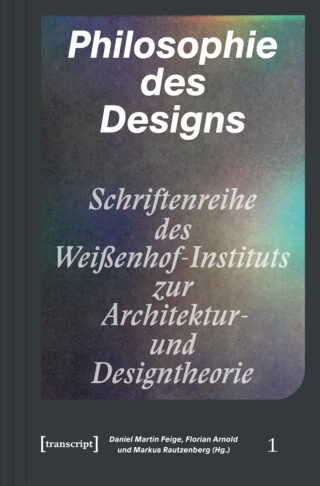
Although design now shapes every aspect of our lives, the subject has so far been somewhat neglected in philosophy. This volume aims to stimulate debate on the relevance and significance of design both within and outside philosophy.
The incisive and outspoken contributions from just under 20 renowned philosophers are redefining the field of discourse surrounding a philosophical theory of design – a tour d’horizon and, even now, a standard work.

The aesthetic tradition in the wake of modernism has treated architecture as a marginal phenomenon. An aesthetics based on the paradigm of autonomous art or on a contemplative theory of aesthetic experience has not always known what to make of architecture, which is invariably linked to specific purposes. Kant’s dictum of ‘disinterested pleasure’ bears witness to this, as does Hegel’s positioning of architecture on the fringes of art.
The contributions to this volume, written by leading experts in the field, explore the question of what it would mean for the fundamental concepts of aesthetics to be rethought on the basis of architecture – and thus an art form that is, by its very nature, always functional: do concepts such as art, sensuality, judgement and experience need to be reformulated in order to do proper justice to the aesthetic characteristics of architecture?
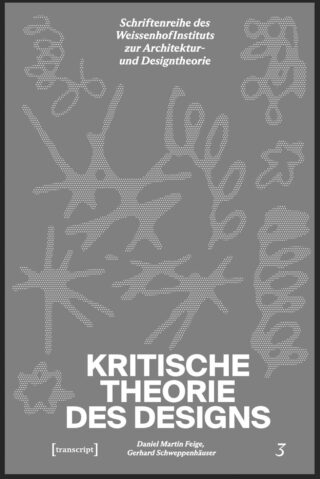
Against the backdrop of the current politicisation of design, its discourses and practices often fail to sufficiently avoid reproducing the very conditions to which they are opposed. The contributors take a more fundamental approach. From the perspective of tradition and drawing on key questions from critical theory, they explore what can meaningfully be understood as ‘criticism’ in design.
Symposia
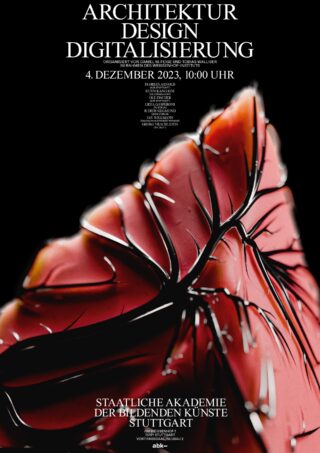
Architektur / Design / Digitalisierung (Architecture / Design / Digitalisation)
December 2023
The digital transformation of society is increasingly redefining what we mean by communication, materiality and coexistence. It is already having far-reaching implications – from AR solutions and digital design to the use of artificial intelligence – even within the context of architectural and design practice. This transformation will be explored from a theoretical perspective during the symposium. Alongside ontological and aesthetic questions, the focus will be on political and social issues.
Featuring talks by Florian Arnold, Huyn Kang Kim, Ole W. Fischer, Lidia Gasperoni, Judith Siegmund, Jan Willmann and Georg Vrachliotis.
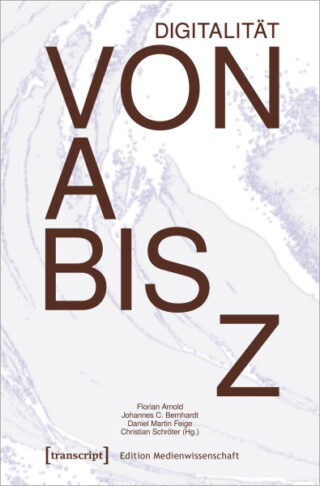
Das Alphabet der Digitalisierung (The ABCs of Digitalisation)
December 2024
Panel discussion on the book ‘Digitalität von A bis Z’ (‘Digitality from A to Z’). From A for ‘algorithm’ to Z for ‘future’: the contributions by leading academics explore a wide variety of facets of digitalisation. As well as providing a concise introduction to each term, they offer an overview of key debates and subject areas, along with a selected bibliography for further reading. This ABC is therefore not only suitable for an academic audience, but also serves as a reliable compendium on the theory and history of digitalisation for anyone interested in the subject.
Panel discussion with Florian Arnold, Veronika Aumann, Johannes C. Bernhardt, Daniel M. Feige, Michael Lüthy, Ulrike Myrzik and Christian Schröter.

Games und Gamification. Book release and conference
December 2025
‘Gamification’ refers to the increasing permeation of all social contexts by infrastructures, formats and, above all, reward systems derived from the realm of gaming, and in particular digital gaming. The symposium’s presentations are devoted to this phenomenon and explore its growing social relevance in both a critical and constructive manner. The symposium will be accompanied by a panel discussion on digital games to mark the recent publication by Feige and Inderst of a handbook on 50 key digital games.
Featuring talks by Florian Arnold, Thomas Arnold, Dîlan Canan Çakir, Daniel M. Feige, Rudolf T. Inderst and Maria Schwartz.
Weißenhof-Lectures
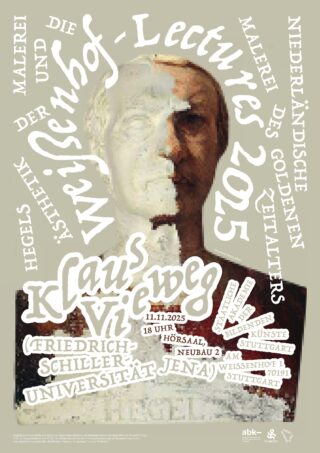
Klaus Vieweg: Hegels Ästhetik der Malerei und die niederländische Malerei des goldenen Zeitalters (Klaus Vieweg: Hegel’s Aesthetics of Painting and Dutch Painting of the Golden Age)
Winter term 2025/26
In collaboration with the Hegel-Haus Stuttgart, Professor Klaus Vieweg will give a talk on the topic ‘Hegels Ästhetik der Malerei und die niederländische Malerei des goldenen Zeitalters’ (‘Hegel’s Aesthetics of Painting and Dutch Painting of the Golden Age’). Klaus Vieweg is an Associate Professor at the University of Jena’s Institute of Philosophy and is one of today’s leading Hegel scholars. To mark the Hegel bicentenary, he published a highly acclaimed biography of Hegel with Beck Verlag. The lecture will draw on his latest book on Hegel’s aesthetics of painting, which was published this year by Meiner Verlag.
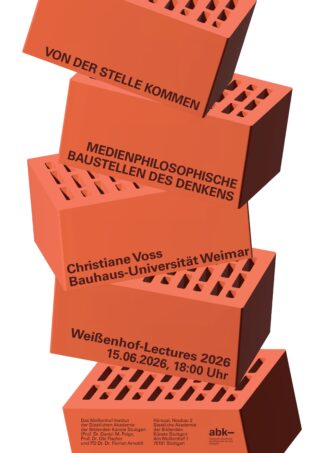
Christiane Voss: „Von der Stelle kommen. Medienphilosophische Baustellen des Denkens“ (Christiane Voss: ‘Getting Off the Spot: Areas for Reflection in Media Philosophy’)
Summer term 2026
The Weißenhof Institute will continue its Weißenhof Lectures in the summer term of 2026. This time, the guest speaker will be Prof. Dr Christiane Voss, Professor of Philosophy of Audiovisual Media/Media Philosophy at the Bauhaus University Weimar, who will give a lecture entitled ‘Von der Stelle kommen. Medienphilosophische Baustellen des Denkens’ (‘Getting Started: Media-Philosophical Construction Sites of Thought’).