
DAAD Summer School in Nigeria and Promos Excursion 2023
Inhalt
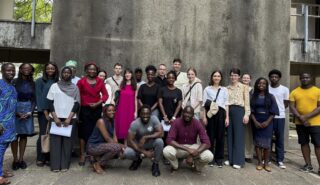
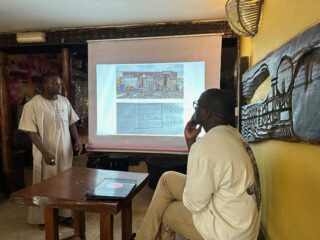
The 2023 DAAD Summer School in Nigeria and the 2023 Promos excursion ‘Everyday Practices’ to Nigeria took place in and around Lagos from 3 to 12 May, led by Prof. Fabienne Hoelzel, Lisa Dautel and Antonia Dürig. Both projects stem from the collaboration with the local NGO Fabulous Urban Nigeria Foundation and the Department of Architecture at the University of Lagos, with which the ABK Stuttgart has maintained a Memorandum of Understanding (MoU) since 2019, following an initiative by Prof. Fabienne Hoelzel’s Class for Design and Urban Planning.
The Project
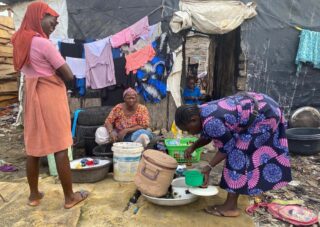
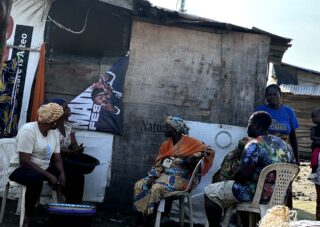
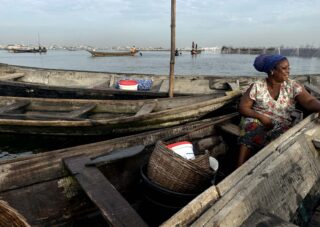
Lagos in Nigeria is a metropolis like no other – not so much because this West African city is expected to become the world’s most populous city by 2100, with 80 million inhabitants, but because there is nothing in Lagos that is truly public. Traditional urban planning usually focuses on publicly planned and organised infrastructure and services. With a population of around 20 million, Lagos is already one of the three most populous cities on the African continent, yet it has virtually no public infrastructure or services. At first glance chaotic and disorganised, the metropolis functions relatively well despite the lack of an effective and efficient central government – this is because at the micro-level, that is, at the level of private households and neighbourhoods, residents repeatedly find creative and resourceful solutions to compensate for the lack of public transport, water and electricity supplies, building land and housing, albeit under conditions of extreme vulnerability.
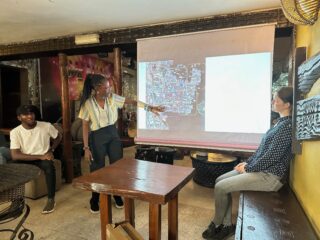
Against this backdrop, and as part of the DAAD Summer School 2023 in Nigeria and the Promos 2023 field trip ‘Everyday Practices’ , 20 students from the ABK and the University of Lagos accompanied seven female residents of the Oworonshoki neighbourhood in their everyday practices and examined these in detail using qualitative methods, with a view to discussing their significance for future decolonial and feminist approaches to urban planning through design-based projects over the course of the semester. The field research methods included interviews, critical mapping, photography and film. The participants worked in intercultural Nigerian-European groups. The results of the field research and subsequent analysis were on display during the 2023 tour in New Building 1, Room 208, as part of the exhibition ‘Oworonshoki, Lagos. Decolonial and Feminist Practices in Urban Design’, and were awarded the 2023 Academy Prize (Akademiepreis) by the Department of Architecture.