The Oddy-Torium – Testing of conservation materials
Inhalt
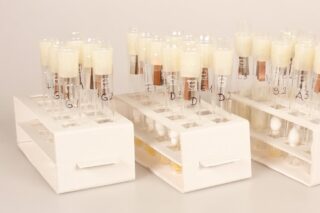
Materials used for the storage and display of art and cultural heritage must not emit any harmful substances, such as acetic acid or hydrogen sulphide, which could damage the exhibits. For this reason, building materials for museum display cases, for example, are systematically tested using a simple, accelerated corrosion test in accordance with the Oddy method. In this test, lead, silver and copper coupons are exposed to emissions from two grams of the material at 60 °C and 100 per cent relative humidity for four weeks in a sealed test tube (50 ml). The test coupons are then visually inspected for corrosion. If the test is passed, the emission of relevant airborne pollutants can be ruled out with a high degree of certainty.
Conservation materials such as adhesives, protective varnishes and consolidants must also be emission-free, as they remain in the object and are thus enclosed with it in sealed display cases or in paintings fitted with protective glazing. Surprisingly, however, many of these have not been tested at all to date. Random samples of some products from specialist retailers were even found to be significantly corrosive. Consequently, the project ‘The Oddy-torium: Testing of Conservation Materials’ now aims to systematically test all commonly used conservation materials. The aim of this large-scale screening of conservation materials is to enable conservators and specialist retailers to make an informed choice regarding the products they use – a crucial step towards improving the quality of restoration work.
Background: Cellulose nitrate
The use of cellulose nitrate products for bonding ceramic shards during conservation is widespread in Germany; they are easy to work with. Specialist restoration suppliers stock the products Mecosan and Archäocoll for this purpose. The latter has been specifically formulated without the usual plasticisers in order to rule out any changes to the adhesive properties caused by their migration. Although the restoration literature highlights the instability of cellulose nitrate (CN) (Selwitz 1988), practitioners rarely take this into account due to their positive long-term experience with the material. The durability of such bonds can be estimated, based on artificial ageing tests, at no less than 100 years (Shashoua et al. 1992). Furthermore, the ceramic material itself is largely inert to the acidic nitrosous gases emitted by cellulose nitrate. But what happens if an artefact bonded in this way is displayed in a showcase alongside more sensitive objects?
Surprisingly, no studies had been carried out on this. As it turned out, this was a dangerous gap in research! When such ceramic adhesives for conservation were subjected to the Oddy test, the most severe corrosion reactions ever observed in Stuttgart occurred on the test plates (‘Popping Stoppers, Crumbling Coupons’, as described by Ziegler et al. 2014). Even silver was significantly affected; nevertheless, CN products (‘Zapon varnish’) remain commonly used as silver-protecting varnishes in restoration. The British product Frigilene failed the Oddy test (Eggert et al. 2019). The American product Agateen No. 27, which is not exported to Germany, has now also been tested negatively by colleagues in Indianapolis (Eggert et al. 2022). Substitute products such as the acrylic dispersion Primal WS 24 also failed the test, presumably due to a sulphur-containing fungicide present in the formulation. This research and the realisation that there was an alarming gap in the research formed the starting point for the Oddy-torium project.
Project Details
Since the 1970s (Oddy 1973), corrosion on test strips made of copper, silver and lead has proved effective for detecting all relevant air pollutants emitted by materials (‘Oddy test’). To accelerate the process, the temperature is raised to 60 °C. As metal corrosion increases exponentially with humidity, the test is carried out at 100 per cent relative humidity (= saturation humidity). By keeping the air volume in the test chamber (a test tube containing 2 g of product sample) small (50 ml), the concentration of pollutants is relatively high. This acceleration allows the results from a 4-week test period to be extrapolated to years of exposure under normal conditions. The significance of this ‘Oddy test’ lies in its extensive, long-standing practical application, due to its simplicity of execution. According to Green and Thickett (1995: 145), no corrosion caused by the outgassing of harmful substances subsequently occurred in any of the materials tested in this way at the British Museum, a finding which has now been confirmed once again by Korenberg et al. (2018: 2). The Oddy test can therefore provide practical assurance, an advantage it holds over more recent methods for measuring the corrosiveness of ambient air. As a simple method that does not require specialised analytical equipment or trained specialist staff, the Oddy test is ideal for the mass screening of restoration materials. Occasional criticisms of the test (e.g. reproducibility, occasional corrosion in blank samples, subjective assessment of the degree of corrosion) have been addressed in a recent publication (Korenberg et al. 2018) through further modifications (e.g. preparation of the metal coupons, reduction in the amount of water).
If a material passes the Oddy test, it can be assumed with a high degree of certainty that no corrosive compounds will be released as gases. However, if it fails the test, the reason for this is not yet known. In Stuttgart, routine analysis of the corrosion products formed using Raman microscopy has proved helpful in this regard: For example, the release of nitrosous gases from cellulose nitrate was detected through the formation of basic copper nitrates, whilst traces of ethyl acetate in a varnish film led to the formation of lead acetate (Ziegler et al. 2014). In addition, in Stuttgart, the main components of materials of unknown composition can be analysed using FTIR spectroscopy.
In individual cases, it is also necessary to resort to direct air analysis in exposure chambers using gas chromatography in order to identify the pollutants emitted. The BEMMA method (Bewertung von Emissionen aus Materialien für Museums-Ausstattungen / Assessment of Emissions from Materials for Museum Fittings) developed by the Federal Institute for Materials Research and Testing (Bundesanstalt für Materialforschung und -prüfung, BAM) has proven effective for this purpose (Wiegner et al. 2012, Horn and Hahn 2020).
Drying of solvent-based products
Some conservation materials dissolved in solvents tend to retain traces of these solvents. Experience in Stuttgart has shown that this can skew Oddy tests (Eggert et al. 2019). Oddy tests on the cellulose nitrate adhesive HMG at the British Museum, carried out after only a few days’ drying, yielded positive results (Korenberg et al. 2018). Samples dried for longer periods in Stuttgart, by contrast, clearly showed signs of corrosion. Evidently, residual solvent still present acted as a stabiliser for cellulose nitrate. Conversely, a sample of the age-stable acrylate Paraloid B 72, dried from an ethyl acetate solution, caused corrosion on the lead coupon. This was due to residual solvent.
The standard protocol (Korenberg et al. 2018) must therefore be supplemented with a specific drying step. Vacuum has not proved effective for accelerated drying. As the Oddy test is carried out in incubators at 60 °C, it makes sense to use this temperature for accelerated drying as well. In the case of Paraloid B 72 in ethyl acetate, it takes at least 10 days for corrosion to cease in the Oddy test. Whether this period is also sufficient for other resins and solvents is being investigated in a comprehensive research programme as part of a Master’s thesis.
Old Conservation Materials
Irreplaceable cultural heritage may be endangered not only by newly introduced conservation materials; often, the objects already have a long history of restoration involving the use of various materials. In the case of older restoration work, the interventions are often insufficiently documented, leaving uncertainty as to the products used. Rather than taking samples from existing materials found on museum objects, reference should therefore be made to the retained samples of commonly used conservation materials from the conservation degree programmes at the Stuttgart Institute for Conservation Sciences (Institut für Konservierungswissenschaften). Their decades-long storage represents a ‘natural’ ageing process, which may influence the emission of harmful substances.
Since 1947, the Stuttgart State Academy of Art and Design has been one of the first official training centres for conservators in Europe. The institute’s history, spanning more than seventy years, has resulted in a unique collection of historical conservation materials comprising approximately 400 samples. On the one hand, it comprises the standard conservation materials of the respective periods, particularly the 1950s and 1960s; on the other hand, it also includes some precursor products which were further developed under the aegis of Kurt Wehlte in collaboration with various industrial firms. Research in this area has so far focused solely on early polyvinyl acetates.
In this project, the aim is to select approximately 50 commonly used conservation materials from the collection, spanning 70 years. The focus will be on materials (e.g. Mowilith, AW2A) of which several containers from different periods are available, most likely with varying compositions, in order to systematically expand research in some cases.
Results to date
Cellulose ethers
Cellulose ethers are used in conservation for a wide range of applications involving a variety of materials. Feller and Wilt (1990) had already pointed out that the individual substances differ significantly in terms of their ageing behaviour. Consequently, all commonly used materials (60 in total) were tested. 33 samples passed the test without any corrosion, whilst 20 caused slight corrosion and can only be used on a temporary basis at most. In the case of hydroxypropyl cellulose Klucel G, the corrosiveness was found to depend on the degree of purity. Among the products currently available, only the pharmaceutical-grade version (Klucel GFPharm) contains no acetic acid residues resulting from the manufacturing process and is therefore non-corrosive.
All individual results were published as open access by Steger et al. 2022 (https://doi.org/10.1186/s40494-022-00688-4 ) .
The findings on cellulose ethers published in Steger et al. 2022 were forwarded directly to specialist conservation suppliers. In particular, the surprisingly corrosive behaviour of recent batches of Klucel G – a product frequently used in conservation – as revealed by the Oddy test was highlighted, and the alternative product Klucel GF Pharm, which had passed the test, was recommended. The responses from the companies were very positive, and the corrosive product is to be replaced. This example demonstrates that the ‘Oddy-torium’ project does indeed generate practical, actionable results which help to raise awareness within the conservation sector regarding the corrosive behaviour of materials used, as well as ensuring better product selection in the trade and thus leading to improved conservation practice.
Saturated salt solutions
Saturated salt solutions can be used to maintain a constant relative humidity (rH) in sealed display cases. However, they are rarely used, presumably due to concerns about corrosive emissions (Hilbert 1987, 181). This has only now been tested using a modified Oddy test. Magnesium nitrate (rH = 53 per cent) and potassium carbonate (rH = 43 per cent) pass the Oddy test and can be used without hesitation. Magnesium chloride (rH = 33%), on the other hand, as used for sensitive glass objects to be displayed in dry conditions, causes corrosion on the copper coupon. (Eggert 2022) (https://doi.org/10.1186/s40494-022-00689-3 )
Bibliography
Robert L. Feller und Myron H. Wilt. 1990. Evaluation of Cellulose Ethers for Conservation. Research in Conservation 3. Los Angeles: Getty Conservation Institute.
Green, L. R., und D. Thickett. 1995. Testing materials for use in the storage and display of antiquities: a revised methodology. Studies in Conservation 40/3, 145-152.
Günter S. Hilbert. 1987. Sammlungsgut in Sicherheit Teil 2: Lichtschutz, Klimatisierung. Berlin: Gebr. Mann
Wolfgang Horn und Oliver Hahn. 2020. Die emissionsarme Vitrine im Fokus – Beschreibung des Untersuchungs- und Bewertungs-verfahrens nach BEMMA. https://netzwerke.bam.de/Netzwerke/Content/DE/Downloads/Nike/bemma-untersuchungsverfahren.pdf?__blob=publicationFile
Capucine Korenberg, C., Melanie Keable, Julie Phippard und Adrian Doyle. 2018. Refinements Introduced in the Oddy Test Methodology. Studies in Conservation 63/1, 2-12.
William A. Oddy. 1973. An unsuspected danger in display. The Museums Journal (Museums Association) 73/1, 27-28.
Laurianne Robinet und David Thickett. 2003. A New Methodology for Accelerated Corrosion Testing. Studies in Conservation 48, 263-268.
Selwitz, C. M. 1988. Cellulose nitrate in conservation. Research in conservation 2. Los Angeles: Getty Conservation Institute.
Yvonne Shashoua, Susan M. Bradley und Vincent D. Daniels. 1992. Degradation of cellulose nitrate adhesive. Studies in Conservation 37/2, 113-119.
Katharina Wiegner, Matthias Farke, Wolfgang Horn, Oliver Jann und Oliver Hahn. 2012. Den Schadstoffen auf der Spur: die Bewertung von Emissionen aus Materialien für Museumsausstattungen mithilfe des neuen BEMMA-Schemas. Restauro 118/3, 38-44.
Project-related publications
2014
Julia Ziegler, Charlotte Kuhn-Wawrzinek, Margarete Eska und Gerhard Eggert: Popping stoppers, crumbling coupons – Oddy testing of common cellulose nitrate ceramic adhesives. In: Janet Bridgland (ed.), ICOM-CC 17th Triennial Conference Preprints, Melbourne, 15.–19. September 2014. Paris: ICOM, art. 0505. https://www.icom-cc-publications-online.org
2019
Gerhard Eggert, Rebekka Kuiter, Capucine Korenberg, Julia Ziegler, Sebastian Bette und Jörg Stelzner: Metal Conservation, Cellulose Nitrate and the Oddy Test. In: Claudia Chemello, Laura Brambilla and Edith Joseph (eds.), Metal 2019 – Proc. of the Interim Meeting of the ICOM-CC Metals Working Group. September 2-6, 2019, Neuchâtel, Switzerland. Paris: ICOM-CC, S. 125-131. https://www.icom-cc-publications-online.org
2021
Gerhard Eggert, Simon Steger und Christoph Krekel: Korrosion durch Konservierung Restaurierungsmaterialien im Oddy-Test. In: Susanne Greiff, Frank Schlütter, Andreas Kronz und Sabine Klein (Hrsg.), Archäometrie und Denkmalpflege 2021, METALLA Sonderheft 11, S. 127-129. https://doi.org/10.46586/metalla.v.2021.i11
2022
Simon Steger, Gerhard Eggert, Wolfgang Horn und Christoph Krekel: Are cellulose ethers safe for the conservation of artwork? New insights in their VOC activity by means of Oddy testing. Heritage Science 10, 53. https://doi.org/10.1186/s40494-022-00688-4
Gerhard Eggert: Saturated salt solutions in showcases: humidity control and pollutant absorption. Heritage Science 10, 54. https://doi.org/10.1186/s40494-022-00689-3
Gerhard Eggert, Gregory Dale Smith und Michael Samide: Testing Silver Lacquers: What about Agateen #27? In: Paul Mardikian (ed.), Metal 2022 – Proc. of the Interim Meeting of the ICOM-CC Metals Working Group. September 4-8, 2022, Helsinki. Paris: ICOM-CC, im Druck. https://www.icom-cc-publications-online.org
Project funding
Deutsche Bundesstiftung Umwelt, ref. no. 35831/01
Project management
Project Assistants
Dr Simon Steger (until February 2022)
Project consultancy
Prof. Dr. Gerhard Eggert gerhard.eggert@abk-stuttgart.de