In Search of Structure: High-resolution X-ray powder diffraction of organometallic salts in the conservation sciences
Inhalt
That I shall see what holds the world
together in its innermost… (Faust I)
To gain a better understanding of the formation of pigments or the degradation of historical materials, conservation science investigates the internal structure of the compounds formed. Electron and Raman microscopes, which are available at the Academy in the Laboratory for Archaeometry and Conservation Sciences, are valuable tools in this regard, though their potential for insight is limited. These often involve salts of carbon-containing acids, such as carbonates, formates and acetates. Some, such as verdigris, were intentionally produced using suitable starting materials (e.g. vinegar), whilst others arise from degradation reactions with the atmosphere (humidity and carbon dioxide, or carbonyl compounds as indoor air pollutants). These compounds have the potential to form metal-organic frameworks (MOFs). Within these, hybrid structures comprising organic and inorganic building blocks are formed, exhibiting a wide range of interesting properties. MOFs are therefore a key focus of current research in materials science.
The exact composition of many of these compounds found on artefacts is unknown. In many cases, single crystals suitable for conventional crystal structure determination could neither be found in the samples nor grown in the laboratory. Data analysis of modern high-resolution X-ray powder diffraction (XRPD) measurements has the potential to circumvent this problem (Dinnebier et al. 2016). In two pilot studies, the crystal structures of a commonly occurring sodium copper formate (Dinnebier et al. 2015) and of thecotrichite (Wahlberg et al. 2015), a efflorescence found on calcareous objects, have already been determined. In both cases, molecular formulae previously assumed in the literature were corrected.
Therefore, unknown naturally occurring or artificially produced corrosion products are to be investigated using XRPD, either in samples taken from objects or from laboratory syntheses:
- Many historical glass objects also contain metal parts. Glass hydrolysis can cause corrosion of adjacent metals. The aim is to study unknown copper, zinc and lead compounds formed with sodium or potassium (from the glass) and the acid residues of short-chain, carbon-containing acids (from the air).
- Calcareous artefacts or zoological specimens (shells, snail shells, etc.) develop calcium- and acetate-containing phases when stored in wooden cabinets due to the emission of organic acids by the wood; some also contain formates of unknown structure.
- Basic copper acetates have been produced as the pigment verdigris for more than two millennia through artificial corrosion. The crystal structures of most of the phases formed in this process have yet to be elucidated, and in many cases their composition has not yet been definitively determined either.
During the three-year project funded by the DFG (start date: 1 January 2017), a series of crystal structures will be determined and, supplemented by corresponding analyses, the molecular formulae will be established. This will help to improve our understanding of the underlying formation and decay processes. Ultimately, this is intended to contribute to the overarching goal of conservation science: the preservation of artefacts for the benefit of all humanity.
Initial findings from the project were already presented by Bette et al. (2017d) in a review article in “Nachrichten aus der Chemie”, the largest German-language chemistry journal.
Glass-metal corrosion: basic potassium lead carbonate
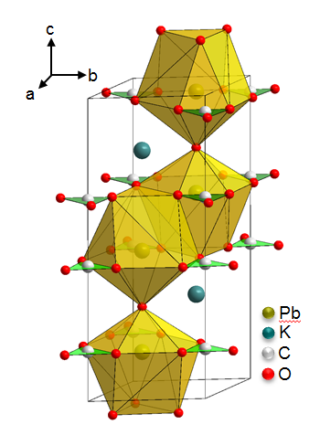
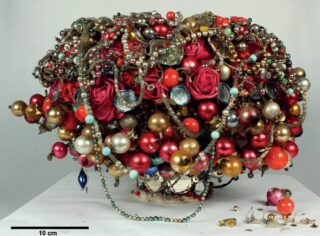
In the 19th century, hollow glass spheres made of sodium-containing ‘soda glass’ were often coated on the inside with molten lead alloys to create a mirror finish. They are often found as decorative features on Black Forest jugs (chwarzwald-Schäppeln). The sodium-containing, alkaline liquid films that form on the glass as a result of a reaction with atmospheric moisture cause corrosion on adjacent metal. In four cases, the basic sodium lead carbonate, NaPb₂(CO₃)₂(OH), was found (Fischer et al. 2014). But what happens with potassium-containing ‘potash glasses’? The analogous potassium compound was indeed found on a glass beer mug from the Veste Coburg with a lead-tin lid. It can also be produced in the laboratory. At the start of the project, its crystal structure was successfully determined (Bette et al. 2017a).
This compound is also of interest in the field of wall painting conservation, as it has been detected in the reaction between soluble wall salts, such as potassium carbonate, and lead pigments, such as lead white, lead chromate, massicot or minium.
Brass corrosion caused by contact with glass: Zinc C
On brass, an alloy of copper and zinc, a range of zinc corrosion products appear alongside copper products when it comes into contact with glass. To date, only zinc formate dihydrate, Zn(HCOO)₂·2H₂O, has been unequivocally identified by X-ray diffraction and Raman spectroscopy, usually alongside sodium copper formate. Andrea Fischer (2016) discovered a further six zinc-containing corrosion products, though their exact composition remains unknown. The compound designated ‘Zinc C’ in the alphabetical list was found on glass earrings with brass settings in the Hamburg Museum, a pair of sun-protective glasses in the Basel Historical Museum, a metal clip for a test tube in a Zurich display case, and on miniatures with metal frames and glass lids in the Württemberg State Museum (Fischer et al. 2019).
This form of corrosion has now also been successfully simulated: to do this, brass sheets are immersed in a solution with a composition similar to that which forms on the glass surface during weathering, and are then exposed to formaldehyde vapours for half a year. Under certain conditions, zinc C also forms. The compound must contain both zinc and copper; the Raman spectrum indicates the presence of formate and hydroxide ions, as well as water of crystallisation. Through high-precision X-ray diffraction measurements on powders and modern analytical methods, it has now been possible to determine the exact atomic positions and, consequently, the formula. It is in fact a basic zinc-copper formate with a somewhat variable copper and zinc content (Bette et al. 2019a) of the complex composition Zn4Cu3(Zn1–xCux)6(HCOO)8(OH)18·6(H2O).
Efflorescence on calcareous objects
Many collection items are made of calcium carbonate (lime): shells, snail shells, coral, birds’ eggs, etc. in natural history museums; limestone sculptures, chalk, marble, lime plaster and lime efflorescence on bronze or ceramics in cultural history collections. Efflorescence on shell casings was first described as early as 1896. The cause was later identified as acetic acid emissions from display cases or the wood of collection cabinets, particularly oak.
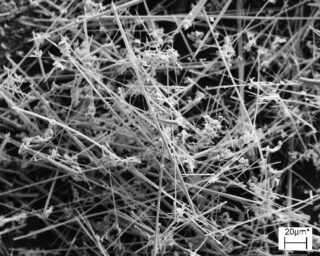
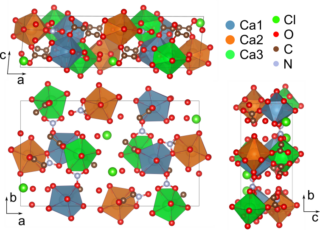
Two calcium acetates are the main reaction products: calclacite, Ca(CH₃COO)Cl∙5H₂O, and thecotrichite. Gibson et al. (1997) determined its composition as Ca₂.₉₅(CH₃COO)₂.₉₁Cl₀.₉₇(NO₃)₂.₀₃∙6.55H₂O using a combination of X-ray diffraction, ion chromatography, infrared spectroscopy, NMR and thermogravimetry. The formula was then rounded to Ca₃(CH₃COO)₃Cl(NO₃)₂∙7H₂O, but the exact content of crystal water in the structure remained uncertain. Single-crystal studies of this important efflorescence failed, as only extremely thin needles are formed. We have since been able to determine the structure of this highly complex compound ab initio from high-resolution X-ray diffraction data. The formula was corrected to Ca₃Ac₃Cl(NO₃)₂∙6H₂O (Wahlberg et al. 2015; Eggert et al. 2016), as it contains only 6 molecules of crystal water. The formula was corrected to Ca₃Ac₃Cl(NO₃)₂∙6H₂O (Wahlberg et al. 2015; Eggert et al. 2016), as it contains only 6 molecules of crystal water.
The crystal structure (see the cover image on the webpage) consists of a network of calcium ions linked by acetate and nitrate ions, forming a metal-organic framework. However, for a number of calcium acetate efflorescences found on shells and artefacts, neither the exact composition nor the crystal structure is yet known. An unknown crystalline, needle-like compound, found on the limestone sinter of black-figure vases and a Syrian bronze bowl, contains not only calcium and acetate ions but also nitrate and formate ions. The crystal structure analysis (Bette et al. 2017c) yields the molecular formula Ca₂(CH₃COO)(HCOO)(NO₃)₂·4H₂O.
If no other anions are present in the soil or from the treatment process, pure calcium acetate forms from the lime. Despite its enormous unit cell, the structure of β-calcium acetate hemihydrate, which has been detected on ceramics, shells and marble, has been successfully determined.
Additionally, the structure of the calcium acetate formate monohydrate found on molluscs was determined and its molecular formula confirmed (Bette et al. 2019c).
Verdigris
Given the importance of colour to humankind, pigments have been studied since the dawn of modern analytical chemistry around 1800. Although most compounds are crystalline, there are still pigments whose structure remains unknown to this day. They are often produced in various ways and occur in mixtures rather than as pure phases. Quantitative phase analysis of pigments could therefore provide insights into their manufacture. Knowledge of their structure can also aid in a better understanding of the stability of colourants; ageing behaviour is a key aspect of conservation science.
Verdigris is a collective term for green pigments that occur as the products of the chemical transformation of copper-containing materials. Here, the name is used only in the narrower sense to refer to various copper acetates that form when, for example, copper sheet is deliberately treated with acetic acid. Such verdigris is one of the oldest artificially produced synthetic pigments; it remained in use until the First World War. It was already mentioned by ancient Greek (Dioscorides and Theophrastus) and Roman (Pliny and Vitruvius) writers. “Verdigris is prepared in many different ways” (Nat. Hist. 34.26), writes Pliny, followed by various recipes.
A series of basic copper acetate hydrates of the general formula x[Cu(Ac)2] ∙ y[Cu(OH)2] ∙zH2O were chemically synthesised. Gauthier (1958) describes the compounds xyz = 215, 115, 120 and 132. Rahn-Koltermann et al. (1991) also prepared 143, but cast doubt on 115, which was subsequently confirmed by Scott (2002). Commercial products are normally mixtures of different phases, depending on the manufacturing process. Scott wrote in 2002: “The previously published X-ray diffraction data for the basic copper (II) acetates are sometimes contradictory and difficult to understand.” This highlights the need for further research, particularly as, in our experience, the syntheses described by Rahn-Koltermann et al. (1991) are difficult to reproduce. To date, only the structure of a 132 phase has been determined from single crystals.
A single-phase powder has already been produced from compound 120. The structure of this compound was elucidated by X-ray diffraction measurements using synchrotron radiation (Bette et al. 2017b). It occurs, for example, when recreating a medieval recipe from the “Mappae Clavicula”, in which copper sheet is exposed to acetic vapours whilst heated in a sealed pot.
Through long-term crystallisation, it has now also been possible to synthesise and determine the structure of compound 215 (Bette et al. 2018). Using these reference data, this basic copper acetate was also conclusively detected in verdigris samples from historical pharmacy vessels. The structure of anhydrous neutral verdigris, which is also identified as a component of historical verdigris, was likewise determined (Bette et al. 2019b).
The research into verdigris follows in the tradition of the ‘Instituts für Technologie der Malerei’ at the Stuttgart Academy of Fine Arts and seeks to resolve a long-standing research problem using state-of-the-art methods.
Bibliography
Sebastian Bette, Gerhard Eggert, Andrea Fischer und Robert E. Dinnebier:
Glass-Induced Lead Corrosion of Heritage Objects: Structural Characterization of K(OH)·2PbCO3, Inorganic Chemistry 56/10, 2017a, 5762-5770.
Sebastian Bette, Reinhard K. Kremer, Gerhard Eggert, Chiu C. Tang und Robert E. Dinnebier:
On verdigris, part I: synthesis, crystal structure solution and characterisation of the 1–2–0 phase [Cu3(CH3COO)2(OH)4], Dalton Transactions 46, 2017b, 14847-14858.
dx.doi.org
Sebastian Bette, Robert E. Dinnebier und Gerhard Eggert:
Zersetzung bringt Neues: Korrosionsprodukte im Museum. Nachrichten aus der Chemie 65/12 (2017d) 1185-1189.
onlinelibrary.wiley.com
Sebastian Bette, Gerhard Eggert, Andrea Fischer, Jörg Stelzner, Robert E. Dinnebier:
Characterization of a New Efflorescence Salt on Calcareous Historic Objects stored in
Wood Cabinets: Ca2(CH3COO)(HCOO)(NO3)2·4H2O.
Corrosion Science 132 (2018) 68-78.
doi.org
Sebastian Bette, Reinhard K. Kremer, Gerhard Eggert, Robert E. Dinnebier:
On Verdigris, Part II: Synthesis of the 2-1-5 Phase,
Cu3(CH3COO)4(OH)2·5H2O, by long-term crystallisation from aqueous solution at room temperature. Dalton Transactions 47 (2018) 8209-9280.
dx.doi.org
Sebastian Bette, Andrea Fischer, Jörg Stelzner, Gerhard Eggert und Robert E. Dinnebier:
Brass and glass: Crystal structure solution and phase characterisation of the corrosion product Zn4Cu3(Zn1-xCux)6(HCOO)8(OH)18∙6(H2O)
European Journal of Inorganic Chemistry 7/2019a, 920-927.
dx.doi.org
Sebastian Bette, Alice Costes, Reinhard K. Kremer, Gerhard Eggert, Chiu C. Tang und Robert E. Dinnebier:
On Verdigris, Part III: Crystal Structure, Magnetic and Spectral Properties of Anhydrous Copper(II) Acetate, a Paddle Wheel Chain.
Zeitschrift für allgemeine und anorganische Chemie 645/15 (2019b) 988-997.
dx.doi.org
Sebastian Bette, Michael X. Müller, Gerhard Eggert, Thomas Schleid und Robert E. Dinnebier:
Efflorescence on calcareous objects in museums: Crystallisation, phase characterisation and crystal structures of calcium acetate formate phases Dalton Transactions, 2019, advance article.
dx.doi.org
Robert E. Dinnebier, Tomče Runčevski, Andrea Fischer und Gerhard Eggert:
Solid-State Structure of a Degradation Product Frequently Observed on Historic Metal Objects. Inorganic Chemistry 54, 2015, 2638-2642.
Robert E. Dinnebier, Andrea Fischer, Gerhard Eggert, Tomče Runčevski, Nanna Wahlberg:
X-ray Powder Diffraction in Conservation Science: Towards Routine Crystal Structure Determination of Corrosion Products on Heritage Art Objects. Journal of Visualized Experiments 112, 2016, e54109, doi:10.3791/54109
Gerhard Eggert, Andrea Fischer, Nanna Wahlberg, Robert Dinnebier, Tomče Runčevski, Rebekka Kuiter, Marian Schüch, Svenja Kampe, Eva Sulzer, Astrid Wollmann:
Efflorescence X? Case Solved: Ca3(CH3COO)3Cl(NO3)2·6H2O! The Research History, Identification, and Crystal Structure of Thecotrichite. In: H. Roemich and L. Fair (eds.), Recent Advances in Glass and Ceramics Conservation 2016. Paris: International Council of Museums – Committee for Conservation (ICOM-CC) 2016, S. 135-144.
Andrea Fischer:
Glas-induzierte Metallkorrosion an Museums-Exponaten.
Dissertation. Stuttgart: SABKS 2016.
archiv.ub.uni-heidelberg.de
Andrea Fischer, Gerhard Eggert, Dirk Kirchner, Harald Euler und Bruno Barbier:
When Glass and Metal Corrode together, IV: Sodium lead carbonate hydroxide. In: Ewan Hyslop, Vanesa Gonzalez, Lore Troalen, Lyn Wilson (eds.), Metal 2013. Edinburgh: Historic Scotland 2014, S. 3-19.
Andrea Fischer, Gerhard Eggert, Jörg Stelzner, Sebastian Bette und Robert E. Dinnebier:
When Glass and Metal Corrode Together, VII: Zinc Formates and Further Unknown Zinc Compounds. In: Claudia Chemello, Laura Brambilla und Edith Joseph (Hrsg.), Metal 2019 – Proceedings of the Interim Meeting of the ICOM-CC Metals Working Group.September 2-6, 2019,Neuchâtel, Switzerland. Paris: ICOM-CC 2019, S. 158-167.
Jean Gauthier:
Etude de quelques propriétés des sels neutres et basique de cuivre des acides formique, acétique, propionique et propositions données par la Faculté. Dissertation Lyon 1958.
Gudrun Rahn-Koltermann, Dieter H. Buss, Robert Fuchs und Oskar Glemser:
Zur Kenntnis basischer Kupferacetate. Zeitschrift für Naturforschung 46b, 1991, 1020-1024.
David A. Scott:
Copper and Bronze in Art: Corrosion, Colorants, Conservation. Los Angeles: Getty Conservation Institute 2002.
Nanna Wahlberg, Tomče Runčevski, Robert E. Dinnebier, Andrea Fischer, Gerhard Eggert und Bo B. Iversen:
Crystal Structure of Thecotrichite, an Efflorescent Salt on Calcareous Objects Stored in Wooden Cabinets. Crystal Growth & Design 15/6, 2015, 2795–2800.
Completion of the project in February 2020
The DFG project was completed in February 2020. Individual measurements of suitable, crystalline samples that are as phase-pure as possible can still be carried out.
Project management
Prof. Dr. Gerhard Eggert
Cooperation partner
Prof. Dr Robert Dinnebier
Max Planck Institute for Solid State Research
Associates
Dr Sebastian Bette
Max Planck Institute for Solid State Research