Prediction of damage to white paper caused by optical radiation in the conservation of cultural heritage
Inhalt
In museums, archives and libraries, works on paper are frequently displayed to the public. The extent of light exposure associated with exhibition traffic is therefore a pressing issue for conservation. Exhibition durations depend largely on conservation decisions, in which the cumulative total light dose is the decisive and limiting factor. To date, it is primarily colour media that have been tested for their light sensitivity. In the case of works on paper, however, the paper substrate is also crucial to the effect of the colour media, as it influences the visually perceived colours, their saturation and brightness. White paper, which is important for the appreciation of works, is subject to change due to ageing, and even pre-aged paper continues to change as a result of light exposure.
With the exception of lignin-rich and optically brightened papers, white paper – by far the most common substrate – is classified as relatively stable in guidelines; a classification that requires further refinement. The project investigated the colour change in papers of varying composition and the use of the microfading test (MFT) to predict future colour change in white paper, including pre-aged paper.
Project details
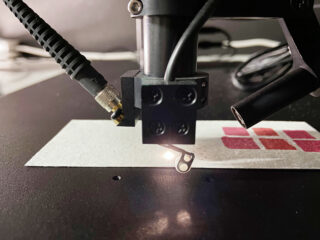
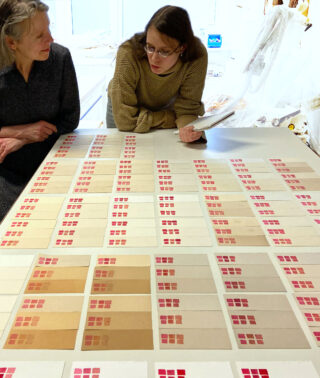
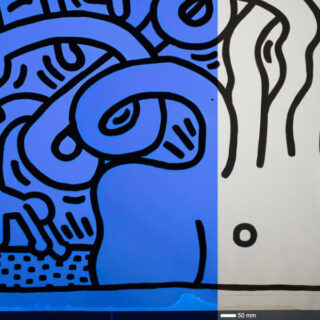
We investigated the age-related colour change patterns of white paper, which we know depend significantly on its key components (cellulose base with calcium salts, iron ions, gelatine, alum, lignin and optical brighteners). We analysed the component-dependent, light-induced ageing of new and pre-aged white papers based on their colour development, with a view to developing a predictive model for their future light sensitivity. Several sets of 37 samples each were used in our investigation of the Microfading Test (MFT). MFT is currently the only tool available for in-situ dose-response testing on cultural heritage. As MFT is increasingly being used in paper collections, we investigated whether commercial MFT devices (with xenon and LED light sources) are suitable instruments for determining the light sensitivity of white paper. We also examined the operating parameters of MFT in general. The interpretability of MFT was considered in relation to a nuanced understanding of the light-induced colour change patterns of white paper.
Project partners
Applicants
- Irene Brückle, Degree programme Conservation of Works of Art on Paper, Archives and Library Materials, State Academy of Art and Design Stuttgart
- Stefan Simon, Rathgen Forschungslabor, Staatliche Museen zu Berlin, Stiftung Preußischer Kulturbesitz, Berlin
- Dagmar Korbacher, Kupferstichkabinett, Staatliche Museen zu Berlin, Stiftung Preußischer Kulturbesitz, Berlin
Research Team
Degree programme Conservation of Works of Art on Paper, Archives and Library Materials, State Academy of Art and Design Stuttgart
- Marie Kern, Academic Associate
- Ute Henniges, Academic Associate
- Irene Brückle, Professor
Rathgen-Forschungslabor, Stiftung Preußischer Kulturbesitz, Berlin
- Giulia Vannucci, Academic Associate
- Stefan Röhrs, Academic Associate, Interim Director
- Stefan Simon, Director, Academic Associate
Kupferstichkabinett, Staatliche Museen zu Berlin, Stiftung Preußischer Kulturbesitz
- Fabienne Meyer, Conservation of contemporary art, Deputy Head of the Conservation Department
- Georg Joseph Dietz, Head of the Conservation Department and Deputy Director
- Dagmar Korbacher, Director
Hochschule für Bildende Künste Dresden (Dresden University of Fine Arts)
- Thomas Prestel, Academic Associate, Teaching and Research Laboratory for Scientific Analysis
Cooperation Partners
- Gangolf Ulbricht, Paper-maker, Gangolf Ulbricht Papier, Berlin
- Antje Potthast, Professor, University of Natural Resources and Life Sciences, Vienna
Publications
Marie Kern et al. “Permanently bright? Predicting light-induced changes in white paper”, ICOM-CC Meeting, Valencia, 2023. icom-cc-publications-online.org
Vorgesehen: „Article collection” in der Zeitschrift Heritage Science „Predicting the light-induced color change of white paper with MFT ”. springeropen.com
Further Information
Funding
Deutsche Forschungsgemeinschaft (DFG)
Project No. 437200876
Funding period
1 April 2021 – 31 March 2024, with a cost-neutral extension until 1 August 2026