Giovanni Battista Piranesi and his workshop: Two newly identified albums in Karlsruhe
Inhalt
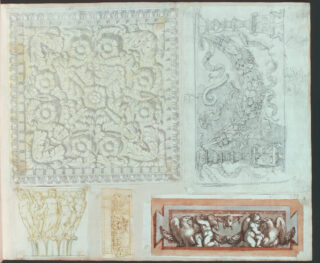
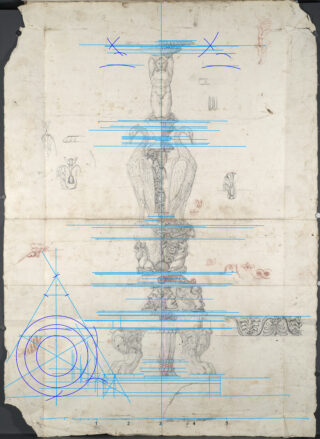
In 2014, the reattribution of two large-format albums containing nearly 300 sheets of drawings to the workshop of the Roman engraver, architect, theorist and antiquarian Giovanni Battista Piranesi (1720–1778) led to a fundamental shift in perspective on Piranesi’s oeuvre. Over the course of the five-year research project, a research framework was established that was particularly relevant to Piranesi’s Roman workshop, especially with regard to his far-reaching influence as a graphic artist on the European reception of antiquity. The drawings were studied at the Staatliche Kunsthalle Karlsruhe through an integrated approach combining art history and art technology, drawing on relevant European and non-European collections.
Project details
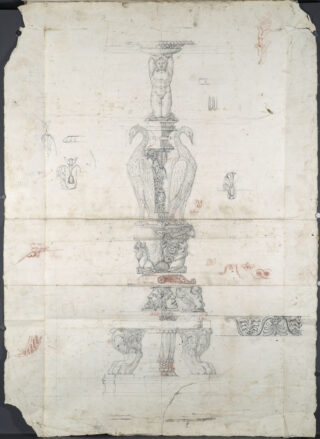
Art-historical research has shown that, as early as the late 1740s and early 1750s, Piranesi and his workshop were intensively engaged in drawing subjects that would later feature in his printed works, beginning with the first edition of his four-volume archaeological opus ‘Antichità Romane’ in 1756. In the early 1760s, a fundamental shift took place in Piranesi’s diverse publishing and antiquarian ventures. Alongside the production of prints, he became increasingly involved in matters of design, such as the production of marble fireplaces and furniture, the sale of ancient marble statues and architectural elements, and new marble creations in the ‘all’antica’ style. The majority of the Karlsruhe drawings were produced within Piranesi’s workshop; some were revised by him, whilst many, created by external artists. were subsequently incorporated into the workshop’s collection of motifs.

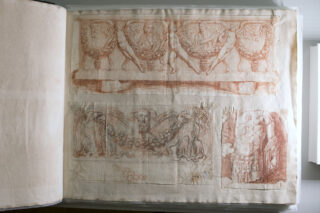
Among the drawing media, conservation research focused on red chalk, which was extensively used for documentary drawing based on antiquities and for copying drawings by means of rubbings and tracing. The red chalk sticks (‘Rötelkreiden’), frequently used for preliminary sketches and copying techniques, were analysed on the basis of microscopically distinguishable characteristics and through FORS measurements (fibre-optic reflection spectroscopy). Noteworthy were the artificially produced, binder-rich black pencils frequently used by Piranesi, which stand out clearly here as an artistic drawing medium in a body of work from the 18th century. Overall, the material-technical analysis of the drawings has brought to light the meticulous, often multi-stage processes of artistic creation.
Two major groups of Italian and Dutch papers were identified amongst the documents. These watermarks were digitally processed and entered into the watermark information system of the Baden-Württemberg State Archives. The watermarks made it possible to establish links between individual drawings in the Karlsruhe albums and works in other collections (the Hamburger Kunsthalle, the National Gallery of Art in Washington and the Morgan Library & Museum in New York).

The traces of historical use encompass a wide range of different phenomena, including oil stains, deposits of red chalk (‘Rötel’) dust and other substances possibly associated with the production of prints, as well as contact marks from tracing paper. Numerous traces of earlier mountings also attest to at least one, and in some cases two, phases of preservation, the first of which presumably took place whilst the work was still in Rome, possibly shortly after Piranesi’s death in 1778.
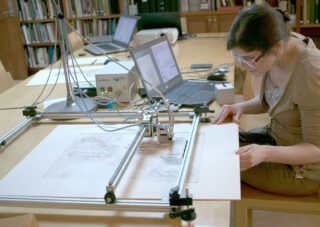
The analysis was supported by transillumination photography, microscopy and multispectral imaging (MSI, in collaboration with Annette Keller, artIMAGING). All the drawings were documented photographically in high resolution using MSI.

Online presence and publications
The database ‘In Piranesi’s Workshop: The Karlsruhe Albums’ presents the results of art-historical and conservation research (in German, with selected sections in English) as well as an exploratory interface:
High-resolution images are assigned to the catalogue entries (including transmitted light and multispectral images: VIS, UVR, UVF, UVFC, IRR, IRFC) as well as watermark documentation. Selected drawings are described in detail. The conservation essays (piranesi.kunsthalle-karlsruhe.de/de/essay/2) cover, amongst other things, the album’s structure, the watermarks, the drawing transfer technique, and the significance of the historical signs of use.
Publications
List of publications on the project page
piranesi.kunsthalle-karlsruhe.de
Authors
Maria Krämer, Judith Becker, Irene Brückle, Lorraine Bryant, Johannes Gfeller, Natascha Wichmann.
Authors in the field of conservation research
Maria Krämer, Irene Brückle, Ute Henniges, Laura Lenfant, Kirsten Drüppel.
Project partners
The project website lists applicants, research partners, those responsible for the research platform, academic essays and academic photographic documentation, as well as those who have contributed to the realisation of the research platform:
Funding
Deutsche Forschungsgemeinschaft (DFG)
Project No. 323516160
Funding period
2017 to 2021