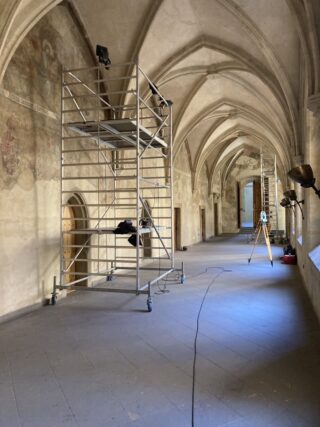
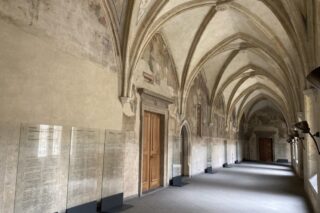
Concept development for the preservation of the cycle of wall paintings in the cloister of the Emmaus Monastery in Prague
Inhalt
The degree programme in the Conservation of Wall Paintings, Architectural Surfaces and Stone Polychromy is a partner in the international project ‘Concept for the Preventive Conservation, Protection and Preservation of the Cycle of Wall Paintings in the Cloister of the Emmaus Monastery in Prague’, which is funded by the German Federal Environmental Foundation (Deutsche Bundesstiftung Umwelt, DBU).
The murals are being studied in collaboration with the Cologne Institute of Conservation Sciences (CICS) at Cologne University of Applied Sciences, which is the project organiser, and the Faculty of Conservation at the University of Pardubice (CZ), which is the second partner in the project.
The Project
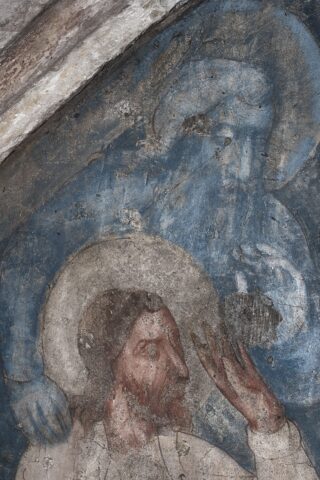
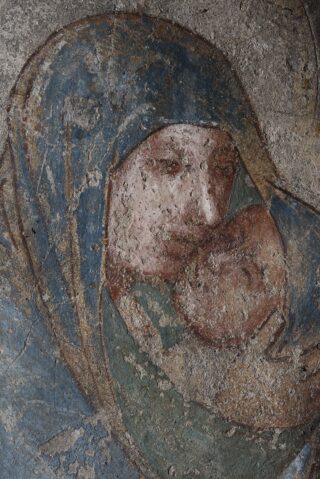
The murals in the cloister of the Emmaus Monastery date from the 1460s and 1470s and form an integral part of the architectural complex of the Emmaus Monastery, which, as a national cultural monument, enjoys the highest level of cultural heritage protection in the Czech Republic. The paintings of the Emmaus Cycle are among the greatest treasures of medieval mural art, not only in Bohemia but also in Central Europe. Scenes from the Old and New Testaments are depicted to the highest standard across 22 vault panels. Due to the effects of war and environmental factors, as well as covering and subsequent uncovering, and inconsistently carried out conservation and restoration measures, the painted panels are in widely varying states of preservation. In particular, the differences in approach taken during the last restoration campaign in the 1960s have shaped their current appearance and are contributing to the ongoing deterioration of the paintings.
The aim of the research project is to develop a concept for the preventative conservation, safeguarding and preservation of the cycle of wall paintings. In order to assess, understand and respond to the complexity of the paintings, an in-depth examination of the current condition of the works is necessary. The restoration and scientific investigations will be carried out using state-of-the-art non-invasive and micro-invasive methods, which guarantee no risk – or only a completely negligible risk – of damage to the murals. In addition to visual inspection, these include, amongst others, multispectral imaging, mobile X-ray fluorescence analysis, Raman spectroscopy and infrared spectroscopy. In addition, the current environmental conditions are examined in relation to deterioration phenomena, and the causes and sources of the damage are assessed. One of the project’s key objectives is the first-ever application of the ABC method to wall paintings – a risk assessment tool combined with an evaluation of cultural value, with a view to achieving the best possible preservation of the site’s cultural heritage and the wall paintings within the constraints of available resources. All surveys will serve as the basis for an in-depth, expert discussion at an international colloquium. The concept for preventive conservation, safeguarding and preservation is intended to serve as a model example, at both national and international levels, of a complex and interdisciplinary approach to dealing with highly significant wall paintings.
Duration: January 2023–December 2025
Project leader (Germany): CICS Cologne Institute of Conservation Sciences, Cologne University of Applied Sciences
Partner institution (CZ): University of Pardubice – State University, Faculty of Conservation
Cooperation partner (Germany): ABK Stuttgart, degree programme in the Conservation of Wall Paintings, Architectural Surfaces and Stone Polychromy
Project funding: German Federal Environmental Foundation, ref. no. 38228/01