Glass-induced metal corrosion on cultural heritage objects
Inhalt
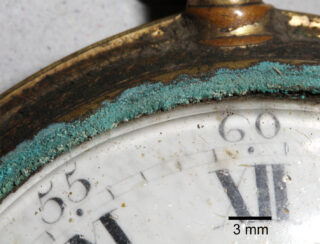
When exposed to formaldehyde, formic acid or acetic acid in indoor air, valuable metal cultural artefacts corrode upon contact with glass (GIMME = Glas-induzierte Metallkorrosion an Museumsexponaten / glass-induced metal corrosion in museum exhibits). In the GIMME projects carried out between 2012 and 2015 at the Chair of Object Conservation (funded by the Friede Springer Foundation), the presence of various compounds of copper, lead and zinc was detected [19]. Using the culturally and historically significant, mixed collection of the German Mining Museum (Deutsches Bergbau-Museum, DBM) in Bochum as a sample, the frequency of glass–metal corrosion was then examined on a pilot basis and the current state of knowledge expanded [17, 25]. Corrosion products on museum objects were examined and identified in Stuttgart (Raman microscope, SEM-EDX, XRD).
Simulation experiments on glass-induced corrosion of metal sheets (e.g. in alkali-carbonate solutions with or without formaldehyde gas exposure, or in contact with model glasses) helped to clarify the dynamics of the corrosive processes and to test the effectiveness of preventive measures (e.g. removal of the emitting anthropogenically introduced materials, protective coatings, pollutant absorbers). Based on the results of the pilot project, guidelines for future prevention were drawn up [28].
The project ‘Corrosion of nationally valuable cultural heritage objects made of glass and metal caused by anthropogenic harmful carbonyl gases in indoor environments: Model-based damage diagnosis and preventive measures” was funded by the German Federal Environmental Foundation (Deutsche Bundesstiftung Umwelt, DBU) from 1 April 2016 to 31 March 2019, as well as through travel grants from the DAAD and IPERION HS ARCHLAB, and an IIC Seed Money Grant.
Subject to agreement, it is also possible to carry out analyses of corrosion products from individual samples at the Academy’s Archaeometric and Conservation Sciences Laboratory, or to conduct surveys of collections.
Current state of knowledge: Copper alloys
Alkaline surface films form on historic glass as a result of a reaction with atmospheric moisture (ion exchange with alkali ions in the glass matrix). In combination with oxygen in the air, these films form ideal electrolyte solutions for the corrosion of adjacent metals. This previously unrecognised form of corrosion was systematically investigated in the Stuttgart GIMME projects between 2012 and 2015 (see bibliography [1–16]). Through the absorption of anthropogenic pollutants from the air, formates are primarily formed (from formaldehyde, e.g. from adhesives, or formic acid, e.g. as emissions from wood-based materials). The frequent occurrence of formiates where metal comes into contact with glass is due to the direct ‘Cannizzaro’ reaction in an alkaline environment, whereby formaldehyde is converted to formiate without the otherwise necessary slow oxidative intermediate step. Acetates (from acetaldehyde or acetic acid) and carbonates (from carbon dioxide in the air, possibly more common in future due to anthropogenically increased CO2concentrations) were also found, albeit much less frequently. For sulphates, such as those frequently found on church windows as a result of sulphur dioxide pollution, there is no evidence of specific glass/metal corrosion products.
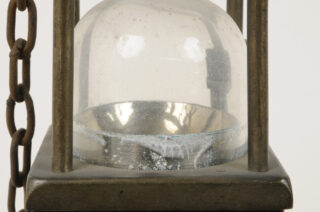
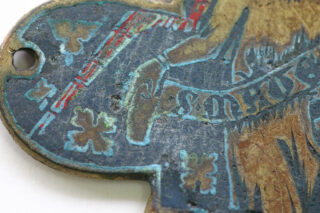
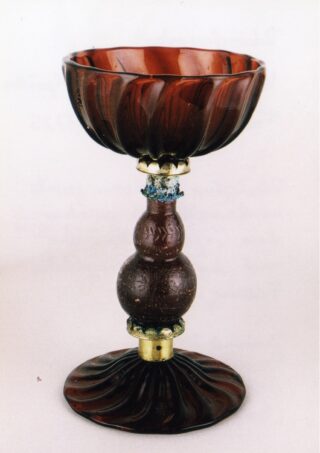
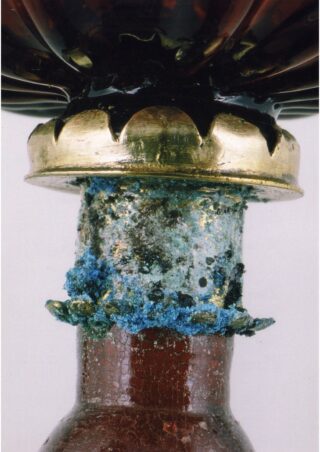
It was soon established that this phenomenon is not as rare as previously thought and does not spare cultural assets of national importance. Corrosion damage caused by glass has been discovered, for example, on medieval silver-set glass gems (the Godehard Shrine in Hildesheim [18] and the Otto-Adelheid Gospel Book/Evangeliar in Quedlinburg [4]), valuable 19th-century daguerreotypes, gold-and-ruby glasses with silver mountings from the Green Vault (Grünes Gewölbe) and precious Limousin enamels (Limousiner Emailpretiosen) [6].
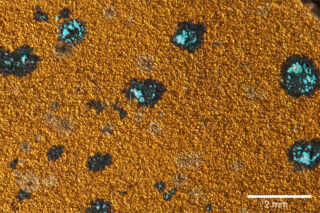
Subsequently, a systematic search for corrosion products was carried out across numerous collections. Corrosion on around 350 museum objects showing signs of corrosion was examined using Raman microscopy, EDX/SEM and XRD, and various copper compounds were detected. The most common (50 per cent) [19, 21] is a sodium copper formate [1, 3, 4, 7, 8], Cu₄Na₄O(HCOO)₈(OH)₂∙4H₂O, whose formula and crystal structure we were able to determine from powder data [13]. It does not necessarily contain acetate, as Trentelman et al. assumed in 2002. In their cases, the sodium originated from the soil or from sodium-containing solutions in the restoration.
The second most common compound is basic copper formate, Cu₂(OH)₃HCOO [5, 19]; in this case, a single crystal was available for the determination of its structure and formula [2]. Often, both products occur side by side, suggesting that the conditions under which they form are similar. Carbonates, such as chalkonatronite Na₂Cu (CO₃)₂∙3H₂O [11, 27]. The basic sodium copper carbonate, Na₃[Cu₂(CO₃)₃(OH)]∙4H₂O, found on the cover glass of a daguerreotype as reported in the literature by Barger and White in 1990, is in fact also chalkonatronite [16].
Acetic acid emissions from oak cabinetry can cause chalkonatrite to transform into a sodium-copper acetate-carbonate of unknown structure. This compound has also been detected on metals in contact with glass [19]. To date, it has not been possible to obtain a suitable, pure, well-crystallised sample to determine its structure and formula.
Current state of knowledge: lead and zinc
When lead came into contact with soda-lime glass, a basic sodium lead carbonate was found [9]. In the very rare other instances of this compound found in the field of conservation science, the sodium originates from wall salts (corrosion of metal wall panels, pigment transformation in wall paintings) or from attempts to precipitate lead white with soda. Potassium-containing glazes can cause the formation of a similar potassium compound [20].
On brass, an alloy of copper and zinc, a range of zinc corrosion products appear alongside those of copper. Zinc formate dihydrate, Zn(HCOO)₂∙2H₂O, has been unmistakably identified using X-ray diffraction and Raman spectroscopy, usually alongside sodium copper formate. Throughout the entire conservation science literature, zinc formate has so far been identified as a corrosion product only very rarely. The fact that this compound was detected in 11 cases on brass-and-glass objects within a short period of time suggests that an alkaline environment is essential for its formation; it therefore also constitutes a case of glass-induced metal corrosion.
A compound initially designated ‘Zinc C’ [19] was detected on twelve different brass objects and successfully synthesised in model experiments [24]. Despite its complexity, the structure and formula of the compound were determined from X-ray diffraction data on powders: Zn₄Cu₃(Zn₁-xCux)₆(HCOO)₈(OH)₁₈∙6(H₂O) [23].
Model-based damage diagnosis
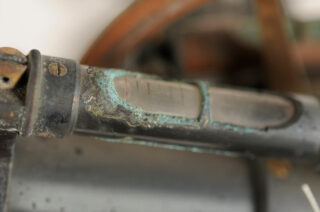
How common is glass-induced metal corrosion in mixed cultural-historical collections: a rather rare exception or almost the norm? Which atmospheric pollutants are involved? Following the survey at the Swiss National Museum [12], the collection of the German Mining Museum Bochum was examined and sampled as a pilot study within the DBU project [17, 25]. Glass–metal combinations are found here, for example, in optical instruments (lenses or spirit levels in metal mountings), glass jugs with pewter lids, miners’ lamps, enamelled objects and technical devices. A portable X-ray fluorescence analyser (p-XRF) (‘X-ray gun’) was used for the first time in this context to determine the alloy composition and glass type without taking samples. Severe cases of corrosion are not common (1–2 per cent of all relevant collection items), but mild cases are (10–20 per cent), the detection of which requires a keen eye [28]. This could be the underlying reason why glass-induced metal corrosion was recognised so late as a damage mechanism.
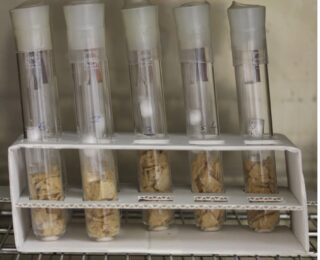
Using the corrosion samples obtained, together with further specifically selected samples from other collections, the frequency of occurrence and the chemical variability of the products are to be investigated further (Raman, SEM-EDX, XRD). The Oddytest has proved its effectiveness in the investigation of ‘suspicious’ display case materials. In addition to providing qualitative information (potential for damage: yes or no?), Raman microscopic analysis of the corrosion products formed on the metal test coupons can also yield clues as to the nature of the corrosive agents, as we have been able to demonstrate in a case study [10].
Despite the significant progress made in the study of glass-induced metal corrosion, our understanding of the products formed remains incomplete [32]. This stands in the way of rational treatment and prevention strategies to protect important cultural heritage. Whilst Raman spectroscopy provides indications of the anions involved and thus allows conclusions to be drawn about the air pollutants present, under an electron microscope, the heavier elements involved can be identified using energy-dispersive X-ray fluorescence analysis (SEM-EDX). However, in the case of unknown phases, there is a lack of reference data for identification. As the compounds are rarely found in a pure or unmixed state, even conventional elemental analysis is insufficient in determining the formula.
If the analyses provide sufficient information on the composition, it is possible to attempt to synthesise even unknown compounds from solutions. If successful, these can serve as references, for example for Raman spectra, and their hygroscopic behaviour can be investigated (at what threshold humidity in the air do the compounds begin to absorb water?).
Using single crystals of sufficient size, whether from the samples taken or from our own crystal growth experiments, crystal structures can be determined using conventional methods [2].
Today, thanks to our collaborators at the MPI for Solid State Research (Festkörperforschung) in Stuttgart, Prof. Dr Robert E. Dinnebier and Dr Sebastian Bette, the formulae can also be determined ab initio from powder diffraction data [14]. Examples of this include sodium copper formate [13], basic potassium lead carbonate [21] and basic copper-zinc formate [23].
Simulation using model systems
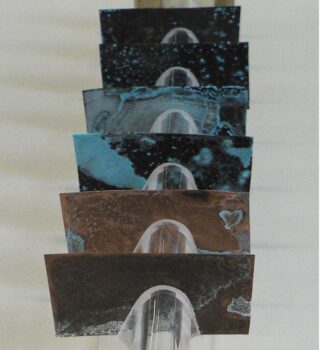
The formation of corrosion products on metal alloys can be simulated in laboratory experiments. To this end, metal coupons of varying composition were immersed in alkaline solutions (e.g. sodium and potassium carbonate or hydrogen carbonate). They were then exposed to various atmospheric pollutants in desiccators. Pollutant concentrations and exposure times were varied in the process. Conditions under which severe corrosion occurs were subsequently used in tests to assess the effectiveness of metal protective coatings or of various pollutant absorbers available from specialist suppliers. Saturated salt solutions, which maintain a constant level of humidity in display cabinets, proved to be particularly effective in preventing corrosion. It has since been demonstrated that they can effectively absorb formaldehyde from the air [31]. This will also be investigated in a new research project with regard to other air pollutants [33].
In addition to the alkali-carbonate solutions, which simulate the composition of the alkaline film on glass, model enamels can also be used. Model enamels were brought into direct contact with metal coupons of varying compositions whilst the relative humidity was freely adjustable.
Detailed results can be found in the DBU final report [26].
Prevention
The findings of the research project provide a practical understanding of the phenomenon. The influence of damaging factors, such as the type of pollutant, its concentration and the level of humidity, gives rise to potential conservation measures:
- Use of protective varnishes
- Reduced humidity
- Removal of sources of pollutants, such as wood-based materials (where possible and provided these are not part of the object)
- Use of suitable pollutant absorbers in display cases.
A practical guide summarises the current state of knowledge for conservators and curators [28]:
- How can glass-induced metal corrosion be identified/where can it be found? (Diagnosis)
- How can damage be prevented? (Preventative preservation)
- What should be done if corrosion occurs? (Interventional preservation)
Bibliography
Bibliography of research carried out to date by the Stuttgart Academy on glass/metal corrosion, organised by year of publication
2008
[1]Gerhard Eggert, Astrid Wollmann, Birgit Schwahn, Elisabeth Hustedt-Martens, Bruno Barbier und Harald Euler:
When glass and metal corrode together.
In: Janet Bridgland (ed.), ICOM-CC 15th Triennial Conference New Delhi. New Delhi: Allied Publishers, 211-216.
Download von https://www.icom-cc-publications-online.org/1846
2009
[2]Harald Euler, Bruno Barbier, Armin Kirfel, Stefanie Haseloff und Gerhard Eggert (2009): The crystal structure of dicoppertrihydroxyformate Cu2(OH)3HCOO.
Zeitschrift für Kristallographie NCS224, 609-610.
2010
[3]Gerhard Eggert:
Corroding Glass, corroding metals: survey of joint glass/metal corrosion products on historic objects
Corrosion Engineering, Science and Technology45/5, 414-419.
[4]Gerhard Eggert, Anne Bührer, Bruno Barbier und Harald Euler:
When Glass and Metal Corrode Together, II: A Black Forest Schäppel and Further Occurrences of Socoformacite.
In: H. Roemich (ed.), Glass & Ceramics Conservation 2010. Corning (NY): Corning Museum of Glass, 174-180.
2011
[5]Gerhard Eggert, Stefanie Haseloff, Harald Euler und Bruno Barbier:
When Glass and Metal Corrode Together, III: The Formation of Dicoppertrihydroxyformate.
In: J. Bridgland (ed.), ICOM-CC 16th Triennial Conference Lisbon, 19.-23. September 2011. Lisbon: Critério-Produção; 2011: 9p.
Download von https://www.icom-cc-publications-online.org/1079
2012
[6] Gerhard Eggert und Andrea Fischer:
Gefährliche Nachbarschaft. Durch Glas induzierte Metallkorrosion an Museums-Exponaten – Das GIMME-Projekt.
RESTAURO 118/1, 38-43.
[7] Andrea Fischer, Astrid van Giffen and Gerhard Eggert:
Glass-induced metal corrosion on museum exhibits (GIMME project).
In: J. Townsend (Hrsg.), IIC 2012 Vienna Congress: The Decorative – Conservation and the Applied Arts. Studies in Conservation57/s1, 355f.
2013
[8]Andrea Fischer und Gerhard Eggert (2013):
Does Lead Enamel Corrode Metal? Evidence From the Examination of 18th Century Snuff Boxes.
In: Hannelore Roemich und Kate van Lookeren Campagne (Eds.), Recent Advances in Glass, Stained Glass, and Ceramics Conservation. Zwolle: SPA Uitgevers, 295-302.
2014
[9] Andrea Fischer, Gerhard Eggert, Dirk Kirchner, Harald Euler und Bruno Barbier:
When Glass and Metal Corrode together, IV: Sodium lead carbonate hydroxide.
In: Ewan Hyslop, Vanesa Gonzalez, Lore Troalen, Lyn Wilson (eds.), Metal 2013. Edinburgh: Historic Scotland, 3-19.
[10] Julia Ziegler, Charlotte Kuhn-Wawrzinek, Margarete Eska und Gerhard Eggert:
Popping stoppers, crumbling coupons – Oddy testing of common cellulose nitrate ceramic adhesives.
In: ICOM-CC 17th Triennial Conference Preprints, Melbourne,
15–19 September 2014, J. Bridgland (ed.), art. 0505, 8 pp. Paris: ICOM.
Download von https://www.icom-cc-publications-online.org/1375
2015
[11]Andrea Fischer und Gerhard Eggert:
Chalkonatronit-Bildung in der Glas-induzierten Metallkorrosion von Museumsexponaten (GIMME).
In: Tanja Gluhak, Susanne Greiff, Katja Kraus und Michael Prange (Hrsg.), Archäometrie und Denkmalpflege 2015. metalla Sonderheft 7, 164-166.
[12] IsabelKeller und Andrea Fischer:
How rare is it? A survey in the Swiss National Museum.
In: Gerhard Eggert und Andrea Fischer (eds.), Glass Deterioration Colloquium – Extended Abstracts. Stuttgart: Staatiche Akademie der Bildenden Künste, S. 41-44.
[13] Robert E. Dinnebier, Tomče Runčevski, Andrea Fischer und Gerhard Eggert:
Solid-State Structure of a Degradation Product Frequently Observed on Historic Metal Objects.
Inorganic Chemistry54, 2638-2642.
2016
[14] Robert E. Dinnebier, Andrea Fischer, Gerhard Eggert, Tomče Runčevski, Nanna Wahlberg:
X-ray Powder Diffraction in Conservation Science: Towards Routine Crystal Structure Determination of Corrosion Products on Heritage Art Objects.
Journal of Visualized Experiments112, e54109.
[15] Gerhard Eggert, Andrea Fischer, Nanna Wahlberg, Robert Dinnebier, Tomče Runčevski, Rebekka Kuiter, Marian Schüch, Svenja Kampe, Eva Sulzer, Astrid Wollmann:
Efflorescence X? Case Solved: Ca3(CH3COO)3Cl(NO3)2·6H2O! The Research History, Identification, and Crystal Structure of Thecotrichite.
In: H. Roemich and L. Fair (eds.), Recent Advances in Glass and Ceramics Conservation 2016. Paris: International Council of Museums – Committee for Conservation (ICOM-CC), S. 135-144.
[16] Gerhard Eggert, Andrea Fischer, Robert E. Dinnebier:
One Heritage Corrosion Product Less: Basic Sodium Copper Carbonate.
Heritage Science4,27. https://doi.org/10.1186/s40494-016-0092-3
[17]Alexandra Schorpp, Miriam Braun, Andrea Fischer, Gerhard Eggert und Michael Prange:
Selten oder nicht? Der GIMME-Test im DBM.
In: Archäometrie und Denkmalpflege 2016, metalla Sonderheft 8, 44-47.
[18]Andrea Fischer und Gerhard Eggert:
Neue Korrosionsprodukte am Godehardschrein – Indizien zur Restaurierungsgeschichte.
In: Dorothee Kemper (Hrsg.), Der Godehardschrein, zur Veröffentl. angenommen.
2017
[19]Andrea Fischer:
Glas-induzierte Metallkorrosion an Museums-Exponaten, Dissertation. Stuttgart: SABKS.
Link: archiv.ub.uni-heidelberg.de/artdok
[20] Sebastian Bette, Gerhard Eggert, Andrea Fischer und Robert E. Dinnebier:
Glass-Induced Lead Corrosion of Heritage Objects: Structural Characterization of K(OH)·2PbCO3, Inorganic Chemistry 56/10, 5762-5770.
2018
[21] Andrea Fischer, Gerhard Eggert, Robert E. Dinnebier und Tomče Runčevski:
When Glass and Metal Corrode together, V: Sodium Copper Formate.
Studies in Conservation 63/6, 342-355.
[22] Andrea Fischer und Gerhard Eggert:
Enamel-induced copper corrosion: A review of research in Stuttgart.
In: Gerhard Eggert (ed.), ENAMEL 2018, Vol. 1: Extended Abstracts. Stuttgart: Staatliche Akademie der Bildenden Künste, S. 42-46.
2019
[23] Sebastian Bette, Andrea Fischer, Jörg Stelzner, Gerhard Eggert und Robert E. Dinnebier:
Brass and glass: Crystal structure solution and phase characterisation of the corrosion product Zn4Cu3(Zn1-xCux)6(HCOO)8(OH)18∙6(H2O).
European Journal of Inorganic Chemistry2019/7,920-927.
[24] Andrea Fischer, Gerhard Eggert, Jörg Stelzner, Sebastian Bette und Robert E. Dinnebier:
When Glass and Metal Corrode Together, VII: Zinc Formates and Further Unknown Zinc Compounds.
In: Claudia Chemello, Laura Brambilla and Edith Joseph (eds.), Metal 2019 – Proceedings of the Interim Meeting of the ICOM-CC Metals Working Group. September 2-6, 2019, Neuchâtel, Switzerland.Paris: ICOM-CC, S. 158-167.
Download von https://www.icom-cc-publications-online.org/3560
[25] Alexandra Schorpp, Miriam Braun, Andrea Fischer and Gerhard Eggert:
In search of frequency: Glass-induced metal corrosion in the Bergbau-Museum.
Metalla25/1, 33-41. https://metalla.org/index.php/METALLA/article/download/9269/8810
[26]Gerhard Eggert:
Abschlussbericht zum DBU-Projekt AZ 33255/01. Korrosion von national wertvollen Kulturgütern aus Glas und Metall durch anthropogene Carbonyl-Schadgase im Innenraum: Modellhafte Schadensdiagnose und Maßnahmen zur Prävention.
Stuttgart: Staatliche Akademie der Bildenden Künste.https://doi.org/10.5165/hawk-hhg/441
2020
[27] Andrea Fischer, Gerhard Eggert und Jörg Stelzner:
When Glass and Metal Corrode Together, VI: Chalconatronite.
Studies in Conservation65/3, 152-159.
[28] Gerhard Eggert und Andrea Fischer. 2020.
Glas-induzierte Metallkorrosion auf Museums-Exponaten (GIMME): ein Leitfaden für die restauratorische Praxis.
Beiträge zur Erhaltung von Kunst- und Kulturgut 2/2020, 105-122.
[29] Katja Franziska Siebel, Lena Hönig, Andrea Fischer und Gerhard Eggert:
Chapter 8: Glass-induced Metalcorrosion on Museum Exhibits (GIMME) – Two Case Studies from the Decorative Arts.
In: Maria V. Orna and Seth C. Rasmussen (eds.), Archaeological Chemistry: A Multidisciplinary Analysis of the Past.Newcastle upon Tyne: Cambridge Scholars Publishing, 124-45.
2021
[30] Gerhard Eggert und Andrea Fischer:
The formation of formates: a review of metal formates on heritage objects.
Heritage Science9, 26. https://doi.org/10.1186/s40494-021-00499-z
2022
[31] Gerhard Eggert:
Saturated salt solutions in showcases: humidity control and pollutant absorption.
Heritage Science 10, 54. https://doi.org/10.1186/s40494-022-00689-3
[32] Gerhard Eggert und Andrea Fischer:
Curious Corrosion Compounds Caused by Contact: A Review of Glass-induced Metal Corrosion on Museum Exhibits (GIMME).
Corrosion and Materials Degradation3/3, 553-565. https://doi.org/10.3390/cmd3030030
[33] Gerhard Eggert, Heiner Grieb und Stephan Brather:
“Salz in der Vitrine*: Neues Forschungsprojekt startet.
RESTAURO 7/2022, 36-39.
Project management
Kooperationspartner
Prof. Dr. Robert E. Dinnebier
Dr. Sebastian Bette
MPI für Festkörperphysik
Project consultancy
Prof. Dr. Gerhard Eggert