Water-sensitive surfaces in Classical Modernism: cleaning with water-based gels
Inhalt
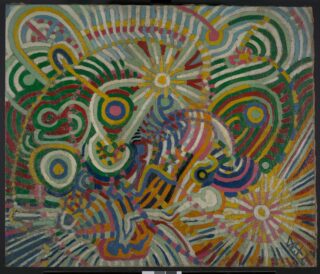
As part of a project for her Master’s degree, Aneka Nowack examined and worked on the painting ‘Ornamental Composition’ by Wilhelm Morgner, dated 1912, at the Städtische Galerie in the Lenbachhaus in Munich. The painting was recently acquired for the collection and is to be prepared for the permanent exhibition.
Due to unfavourable storage conditions before and during the Second World War, around one-sixth of the original painting was lost and the textile support was damaged. It was therefore restored in the 1950s and 1960s: tears in the fabric were stabilised by attaching a backing of fabric to the reverse, and damaged areas of the painting were extensively repainted. Finally, the painting was given a glossy varnish, on which a yellow-grey film of grime has accumulated over the years.
Aneka Nowack carried out extensive testing to find a method that would specifically remove only this layer of dirt without damaging the underlying painting, parts of which are sensitive to water. The most suitable solution was a water-based gel (hydrogel), relatively new in the field of conservation and restoration, made from three natural thickening agents (xanthan, konjac glucomannan and agar-agar). The gel, which was produced in-house, is transparent and elastic, enabling it to adapt very well to the various surface textures of the painting. Due to the gel’s special consistency and the individually adjusted application time, even the areas of paint that were more sensitive to water could be cleaned.
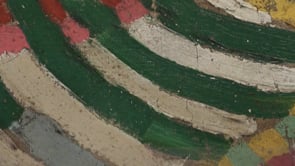
The video shows how, after a short application time, the gel dissolves the grey dirt in the white area and absorbs yellowish particles into its structure. The gel can then be carefully removed. The remaining grey residue is subsequently removed using a slightly damp PU sponge.
An dieser Stelle ist ein externer Inhalt von Vimeo eingebunden. Durch das Ansehen des Inhalts hat der externe Anbieter Zugriff auf Ihre Daten. Weitere Informationen finden Sie in unseren Datenschutzhinweisen.
As a result, the colours of the painting is once again approaching its original appearance.
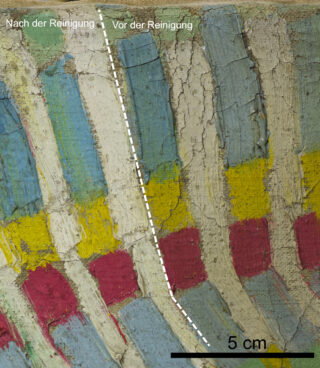
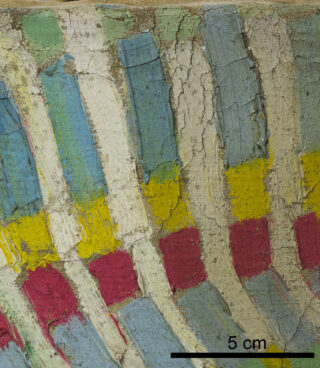
The project was supported by the Förderverein Lenbachhaus e.V. and supervised by the Lenbachhaus’s conservators Isabel Gebhardt, Franziska Motz, Isa Päffgen and Daniel Oggenfuss, as well as by Prof. Dr Wibke Neugebauer.