




Architecture
Inhalt
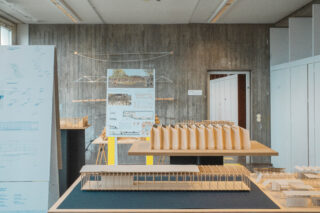
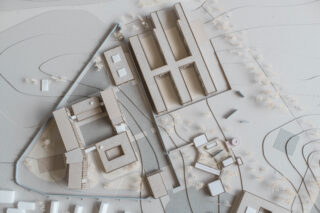
The architecture degree programmes at the ABK Stuttgart are characterised by a strong artistic focus. The emphasis is on artistic and architectural design, whilst also incorporating technical and engineering aspects. The design process encompasses all scales of architectural practice: from individual objects through to buildings and the city as a whole. Openness and process-oriented thinking are central principles for shaping architecture in a way that is socially relevant and forward-looking. Teaching encourages interdisciplinary and individual approaches in order to train architects with strong design skills. In the Germany-wide university rankings, the Department of Architecture at ABK Stuttgart is exceptionally well-positioned.
Course projects
Bachelor’s degree
Duration and degree
| Duration of study | Standard period of study 6 semesters |
|---|---|
| Degree | B.A. (Bachelor of Arts) |
| ECTS | 180 |
Course content
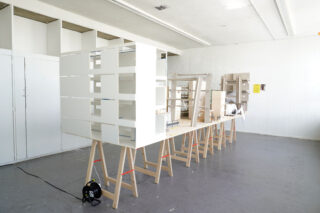
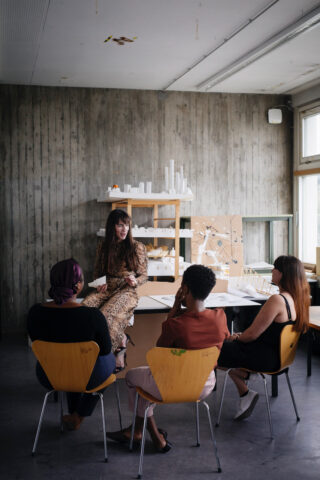
The six-semester Bachelor’s degree programme in Architecture at the ABK Stuttgart is characterised by intensive supervision in small classes. In the first year of study, the core modules are undertaken alongside students of Industrial Design. The programme covers all aspects of architectural practice, from building design to urban planning and from structural to experimental design. Practical projects and theoretical lectures complement one another, with the focus on working on students’ own designs. Lectures, excursions, work placements and interdisciplinary activities, as well as work in the ABK Stuttgart workshops, round off the programme. All students are allocated their own studio space from day one.
Regulations
Master
Duration and degree
| Duration of study | Standard period of study 4 semesters |
|---|---|
| Degree | M.A. (Master of Arts) |
| ECTS | 120 |
Course content
The Master’s programme in Architecture offers an intensive, artistically oriented architectural education in small classes with a high staff-to-student ratio. The programme focuses on fostering students’ own architectural work. This programme is characterised by its range of optional seminars and design courses, with an emphasis on design and discourse. The integration of research and teaching, as well as interdisciplinary collaborations, are further key elements.
The Master’s thesis is an independent project chosen by the student, supervised by a committee. In the third semester, a research project prepares students for this in terms of both content and methodology. Each student is allocated their own studio space and may use the Academy’s wide range of workshops. Selected lectures are taught in English. International exchange opportunities enrich the course.
Regulations
Classes and professorships



Workshops


Prizes and awards
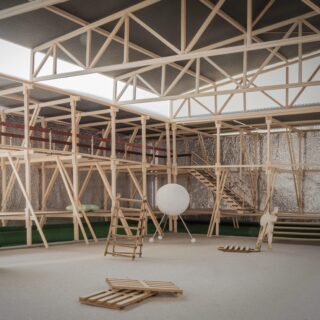
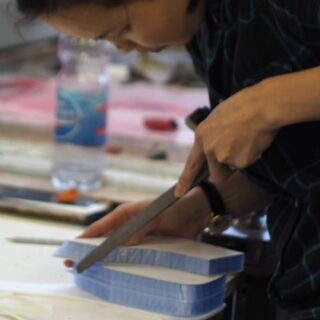
Academy Awards 2024: Lilian Schwörer and Yeji Wachter for their ‘Experimentalbau Stroh’ (‘Experimental Straw Building’) (Prof. Dr.-Ing. Stephan Engelsmann, AM Oliver Kärtkemeyer and AM Tobias Laukenmann); Esther Chloe Rodriguez-Krämer for her Master’s thesis ‘Zwischen Freiheit und Überwachung: die Architektur des Gefängnisses als Mittel der Bestrafung’ (‘Between Freedom and Surveillance: The Architecture of the Prison as a Means of Punishment’); Theresa Weigand for her independent project ‘Umbauen! Transformationsideen für das Leitzareal’ (‘Redevelop! Ideas for the Transformation of the Leitz Site’); students from the Class for Design, Architecture and Building Typology (Prof. Marianne Mueller, AM Christian Gork) for the interdisciplinary project in collaboration with the Workshop for Glass Painting and Glass Processing (KTL Claudia Heinzler) of the Art Department
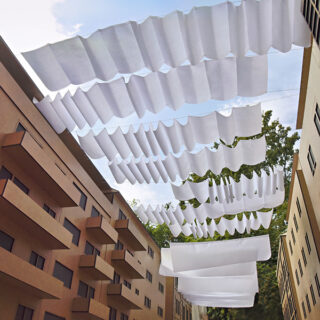
‘10 m² Baukultur’ competition organised by the Federal Foundation for Building Culture: Prof. Matthias Rudolph, Building Technology and Climate-Responsive Design class (Prof. Matthias Rudolph, AM Dipl.-Ing. Christian Degenhardt, AM Mohammad Hamza M.Sc., AM Ines Viola Schlecker M.A.), Class for Structural Design and Structural Engineering (Prof. Dr.-Ing. Stephan Engelsmann, AM Oliver Kärtkemeyer M.A. Arch.)
Heinze ArchitekturAWARD 2024: Nayeon Kim, Isabella Silva Atlemani
Research



Cooperations
Official university partnership with the DGNB Academy
ABK Stuttgart is an official university partner of the DGNB Academy, the Deutschen Gesellschaft für Nachhaltiges Bauen (German Sustainable Building Council). This partnership enables ABK students to train to become a DGNB Registered Professional during their studies by sitting the relevant examination. The modules on the Master’s programme, such as the Nachhaltiges Bauen (Sustainable Building) seminar led by Prof. Matthias Rudolph (Class for Building Technology and Climate-Responsive Design), provide the essential foundational knowledge required to prepare for the examination.
AA Visiting School Stuttgart: The Laboratory (since 2017)
The Laboratory is a ten-day course run by the Architectural Association School of Architecture (AA School), London, at the ABK Stuttgart, open to students from all over the world.
aaschool.ac.uk/
IBA Summer School (since 2017)
The IBA’27 Schools facilitate the transfer of knowledge, provide insights into planning and design processes, and open up new perspectives on urban development processes. school.iba27.de
SenseBox Pro (2020–2022)
The ABK FAB LAB (Prof. Anne Bergner, AM Sebastian Lotz M.A.) was a partner of the University of Münster (Institute of Geoinformatics) as part of the BMBF’s Open Photonics Pro funding programme. sensebox.de
Exchange programmes
Students at the ABK Stuttgart have the opportunity, through various exchange programmes, to study for one or up to two semesters, free of tuition fees, at a partner university in or outside Europe. An overview of our university partnerships can be found on our website. The Department of Architecture also has further specific partnerships with the University of Stuttgart, ECL-EiABC-AAU, Addis Ababa, Ethiopia, and the University of Lagos, Nigeria.
Publications
Fabienne Hoelzel: „Lagos, Nigeria: A Study in Anarchy and Negotiation“, in: Bhumi, The Planning Research Journal, Displaced Urbanism, 9(1), S. 18–34. bhumi.sljol.info
Fabienne Hoelzel: „Lernen von den Slums – am Beispiel Lagos“, in: Almanach Entwicklungspolitik 2023 „Urbanisierung im Globalen Süden“. Das Caritas-Jahrbuch zur humanitären Schweiz, S. 165–174. caritas.ch
Fabienne Hoelzel: „Towards a ‘hybrid’ governance approach: The way out of the urban development crisis in Lagos, Nigeria? A critical assessment with Makoko as a case study“, in: Informal Settlements of the Global South, ed. Gihan Karunaratne, London: Routledge, S. 217–235. routledge.com
Fabienne Hoelzel: „Wunder Lagos“, in: Modulor, 03/2023, Zürich, S. 20–33.
Fabienne Hoelzel, Ute Vees und Boluwatife Soremi: „Inter-African Perspectives. In Search for a Third (African) Way“. Entwerfen und Städtebau, ABK Stuttgart, Oktober 2022.
Constantin Hörburger: „Staatliche Verwaltungsschule Stuttgart, Rolf Gutbier (1971)“, in: Bund Deutscher Architektinnen und Architekten BDA Baden-Württemberg (Hg.), Gefährdete Arten – Erhalt vs. Abriss (Ausstellungsbroschüre), S. 19–22.
Sebastian Lotz, Nguyen-Truong Le und Jens Wizl: „Mobiles Photoniklab für Open Innovation und Nachwuchsförderung“, in: Gerd Häusler und Christian Faber (Hg.), Proceedings 124. Jahrestagung der Deutschen Gesellschaft für angewandte Optik DGaO , 2023.
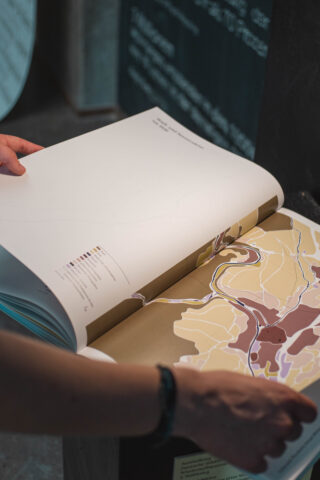
Fahim Mohammadi (Hg.): „UNFOLD – Kartografien des Ästhetischen“. Vierte Ausgabe der Grund-klassenpublikation der Studiengänge Architektur und Industrial Design der ABK. Inkubator, Klasse für Grundlagen der Gestaltung und experimentelles Entwerfen, ABK Stuttgart, 2023.
Matthias Rudolph et al.: „Im Gespräch mit Franziska Leeb“, in: IBA Wien 2022, Neues soziales Wohnen (Hg.), KLIMA.WECHSEL Environmental? Social? Governance? , Band 40, Wien 2022, S. 21–23. ISBN 978-3-903474-24-6.
Matthias Rudolph: „Status quo – What’s Next?“, in: IBA Wien 2022, Neues soziales Wohnen (Hg.), KLIMA.WECHSEL Environmental? Social? Governance? , Band 40, Wien 2022, S. 16–20.